Pages

Wednesday, July 13, 2011

Ushiku no Daibutsu: The Big Buddha statue


We had noticed a Big Buddha statue on our way to Narita airport (from Iwaki) a few times and were curious to visit the place. But not many people had recommended the place and we didn’t even know it’s name. Not sure why the place is not on the recommended places to visit despite the statue being one of the tallest Buddha statues in the world and definitely the tallest statue in Japan.
Ushiku Daibutsu, as the statue is known, is located in Ibaraki Prefecture, a short distance after exiting the Joban expressway for Narita airport. The place is also close to Tsukuba city in Ibaraki prefecture.
 The statue at 120 meters (394 feet) high is the third tallest statue in the world and the tallest in Japan.
The base of the statue is 10 meters high and the lotus platform also measure 10 meters high. 
The statue weighs 4003 tons and is bronze plated . The inside of the statue is actually a 4 storeyed building which has a museum. 

The first floor is named “Infinite Light and Infinite Life” and it has lighted displays and a dark space with a bright light beam which implies “Amida (Buddha) is the light of the world”.
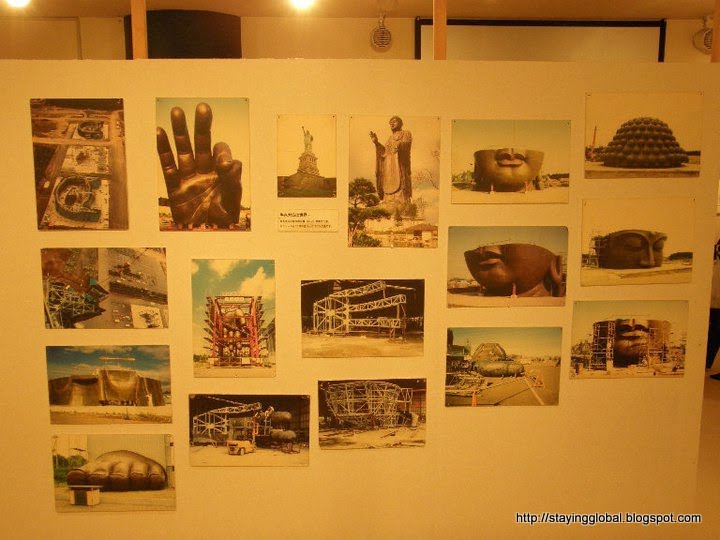
The 2nd floor is dedicated to scriptural studies. Pictures and diagrams depicting various stages of the building of the Buddha statue are also on display.


 A 1:1 scale replica of the Buddha’s toe is also on display.
 3000 golden Buddha statues are displayed on the 3rd floor.

The fourth floor which is 85 meters above ground has an observation deck which offers a panoramic view of the surroundings. The deck is at the chest of the Buddha statue. The three lines near the statue's chest are actually the lookout windows can be seen in the picture below.
The statue is surrounded by a big garden. 


A huge Buddha’s head is installed in the garden.
A small petting zoo of small animals, mainly rabbits, is also located close to the Buddha statue.

Address: Kuno- 2083, Ushiku town, Ibaraki Prefecture 299-1601

Phone: 029-889-2931

Opening Hours: 9:30-17:30 hours
                      (Gates close 30 mins before closing; Closes early between March and September)

Closing Days: Open 365 days

Entrance fees: 500 yen for entrance: 800 yen for entering the Buddha statue/museum

Free car Parking available

Getting inside a straw hat

Japan is a country with innumerable shrines and temples- some small and some large. While the shrines and temples in major tourist destination cities like Kyoto, Kamakura, Nara or Nikko are popular in Japan and abroad, very few foreigners or tourists usually get to visit these little shrines or temples. Many a times, these smaller shrines or temples have a lot of history or art, at the same time offering more calm and peace to one’s mind. One such experience was an unplanned visit to Kasama. We had visited the Naritasan Shinshoji temple and were on our way home to Iwaki from Narita. It was still early in the afternoon and we felt we could make a stop at some calm and peaceful place before we returned home. That was when we decided to stop at Kasama.

Kasama is a town near Mito city in Ibaraki prefecture. The name of this town means "Inside a Straw hat". The reason behind this is that the city's centre , the hat in this case, is connected by many small towns which form the brim of this straw hat. Interesting or "Omoshiroi" as the Japanese say.

Kasama town is home to one of Japan’s important Shinto shrines- Kasama Inari shrine. Also known as Kasama Taisha or Jinja shrine, the Inari shrine was built in the late Edo period and has been designated a national treasure. It is similar to other Inari shrines in Japan and is counted among the three largest Inari shrines in Japan. A big Torii stands at the entrance, followed by a small path leading to a Wooden gate. 

A few metres ahead stands the main hall.  

However the shrine is much smaller and less crowded than the Inari shrine in Fushimi.

 Like all Inari shrines, statues of the Inari messenger “kitsune” (fox) can be found in abundance here too. 


Address:  1, Kasama , Kasama shi, Ibaraki ken, 309-1611
Phone: 0296-73-0001

Close by is another important shrine – Kasama Izumo Shrine. This shrine is also known as Hitachi Izumo shrine and is one of the most visited shrines on New Year’s Day. I heard about this shrine from my Japanese friend, who visits the shrine each year in January. She has a lot of faith in the Omikuji or “Fortune chit” of this shrine and each year makes a trip to know what lies in store for her in the year ahead. The shrine is located on a hilltop. 

The shrine’s speciality is the enormous rope made of Rice straw which is hung on the shrine’s façade.

 It is said to weigh about 6 tons ! Worshippers throw coins upwards so that they remain stuck in the straw.

 It is believed that if they succeed, the thrower will be bestowed with good fortune in the year ahead.

This shrine is reputed to be built on the lines of the oldest Shinto shrine in Japan, the Izumo Taisha shrine in Shimane prefecture.

This shrine will celebrate its 20 year in 2012.

Check the site for more details: http://www.izumotaisha.or.jp/  ( Japanese only)

Shrine timings: 8:00 to 17:00 hrs everyday.

Address: 2001 Fukuhara, Kasama, Ibaraki ken

Phone: 0296-74-3000

Kasama town has much more to offer for travelers. The town is also famous for its pottery and sake breweries.

For more details check out this link:

Tuesday, July 12, 2011

A visit to the Naritasan Shinshoji Temple

In February this year, my parents came to Japan to visit us. Their flight from India was to arrive early in the day. We had driven down to Narita Airport to receive them. Since it was a  Saturday morning, we decided that we would begin their Japan sightseeing tour right from the airport, provided they were not exhausted after their 9 hour flight. They seemed fresh and raring to go and we decided to go ahead with our plan. We had not decided which place to take them first and were discussing the options when we noticed a temple complex to our left. We just followed the direction of the temple and were surprised to see a huge temple complex, right next to the Airport complex! None of our friends had ever mentioned about this temple. Moreover our previous visits to this area had been either too early in the morning or late in the night and we had not noticed the temple in the darkness.

Naritasan Shinshoji is one of the three famous traditional temples in Japan’s Kanto region. This temple was founded in 940 AD by Priest Kanjo.

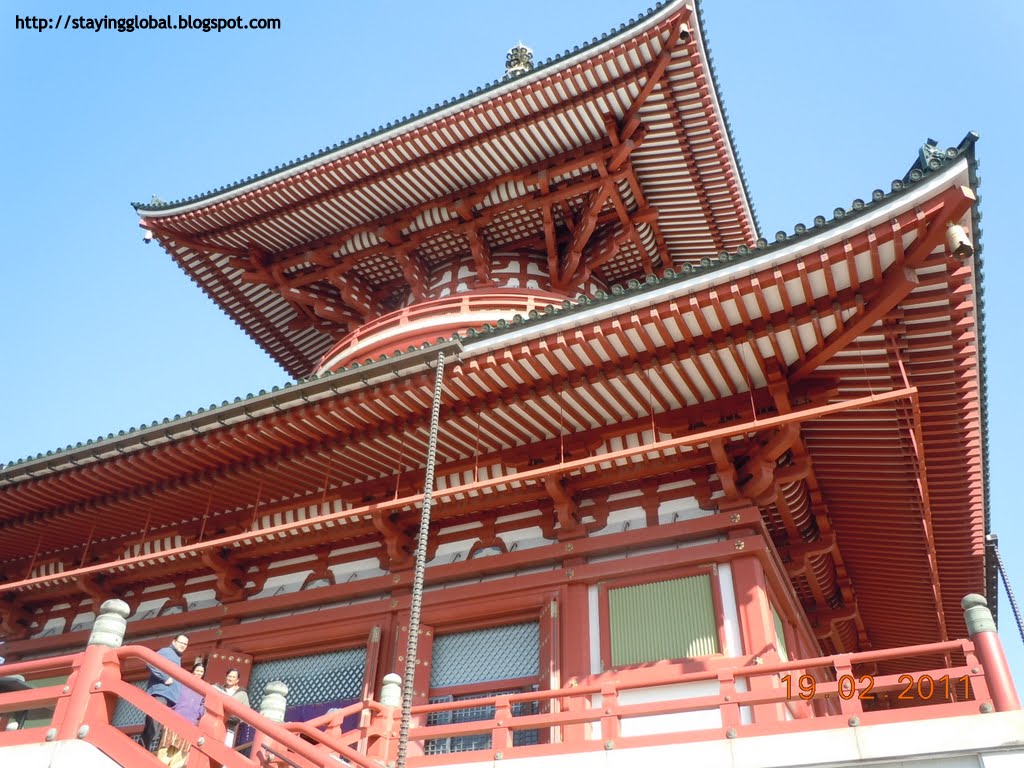
This huge complex consists of many buildings in various shapes and styles. We first visited the “Great Pagoda of Peace”. This pagoda was built in 1984 for World peace. 


A huge idol of Fudomyoo is seated in the main Hall called Myooden.


The hall below has a display of various artefacts , photographs and scriptures. We walked around in the Naritasan Park below for some more time. We then proceeded to the main temple complex which is a little ahead. A walking path through the Naritasan Park also leads to the Main temple complex. 


First we visited the Komyodo Hall, Gakudo Hall and few other buildings in the vicinity. A flight of steps took us down to the “Great Main Hall” which was full of worshippers. A religious ceremony “Goma” or the Sacred Fire rite was being conducted in The Main Hall. A priest was dedicating offerings to the ceremonial fires while other priests were chanting prayers. This reminded us of the Hindu religious ceremonies back home in India. We then proceeded towards the 25 m high Three Storied Pagoda which dates back to the 18th century.


The best time to visit this temple is between mid February and mid April when Apricot and Cherry blossoms are in full bloom, adding to the beauty of the temple. Apricot blossoms were beginning to blossom when we visited the temple.

Like all other tourist and religious places in Japan, there are many shops selling souvenirs and eatables outside. There is ample parking space further ahead, near the Niomon gate.

Definitely worth a visit. 

For more details visit: http://www.naritasan.or.jp  

Address: Narita city, Chiba Prefecture 286-0023

Phone: 0476-22-2111

Monday, July 11, 2011

Sakura : The Cherry Blossom

Having written about Plum Blossoms in my previous post, I could not resist the urge to do a quick followup with a post on Sakura. A blog about Japan and not writing about Sakura, unimaginable !


Towards the ends of spring, Japan’s floral beauty is at its peak. It is the time when the last of the blossoms is in full bloom. Only one thing seems to be on everyone’s mind. Sakura. To the uninitiated, Sakura is the Japanese name for Cherry Blossoms. The weather is perfect- neither warm nor cold. The mood is upbeat in line with the season. The blossom laden trees are truly a breathtaking sight. A nature lover couldn’t think of a better time to be in Japan.


In a manner similar to the Plum Blossoms, cherry blossom also begins in south Japan, Okinawa to be precise, somewhere around January and gradually moves towards the other parts of Japan. By the time the blossoms begin in Tokyo or Tohoku region it is late March. 


The season ends in Hokkaido around mid April. Locals religiously follow the blossom forecast announced from time to time by the weather bureau and visit the shrines, parks and blossom spots in large numbers. It is a merry making time with families and friends gathering together for Hanami parties under the cherry blossom time. Sakura Hanami parties started around the Heian period and owe their origin to the Ume Hanami parties. Like many other Japanese customs, this custom also began with the royal family and elite holding elaborate Hanami ceremonies. Over a period it became a widely followed custom among common public.


The importance of Sakura is not limited to these public Hanami ceremonies. A 100 yen coin has a picture of Sakura on it. The sakura design is common on cloth, kimonos, crockery, Japanese paintings and even stationery like origami paper. The name Sakura is also a common name among Japanese girls, though these days the trend seems to have changed. Popular items like chocolates and biscuits also have a seasonal version like this Sakura special Kit Kat. 


Even during the Imperial days, it is said that the Japanese planted cherry trees in places which they conquered and these trees indicated that land as Japanese territory. Part of China and South Korea which were under Japanese rule for some time still have Cherry Blossom trees which were planted during the Japanese rule. Even in South Korea, where I lived for a short period before moving to Japan, Blossom viewing is popular. Many of the cherry trees planted there during the Japanese rule are said to have been destroyed to indicate the end of Japanese rule.


In Japan it is popular to visit Shrines or parks at night to view Blossoms. During the peak of the blossom season, the shrines or parks which hold the Hanami Matsuri light up the sakura trees with lanterns and electric lights. The beauty of the blossoms is highlighted against the dark night sky due to this lanterns. A full moon night complements the blossom lights well and locals turn up in large numbers to enjoy this spectacle.


Though I had seen images of Sakura even before I came to Japan, I was not aware that many varieties of Cherry blossom are trees which do not produce fruit and cultivated purely for their ornamental purpose. Also the Japanese cherry looks and tastes different from the American cherries which I had tasted before.


Every year millions of tourists from all over the world travel to Japan during the Cherry Blossom season. Cherry Blossom season is one of the best seasons to visit Japan, though airfares may be a bit expensive around this time of the year.

Sakura has a place even in the Japanese cuisine. The season’s speciality is a traditional sweet , a confectionary to be precise, called “Sakura mochi”. It is a rice cake with a red bean paste stuffing and which is rolled in a sakura leaf. The leaf gives a distinct aroma to the sweet and needs to be eaten alongwith the mochi.  Sakuramochi  is traditionally eaten on March 3rd which is the day of Hina matsuri, also called the Girl’s festival day. On this day it can be purchased at most stores and confectioners and even at the convenience stores like 7 Eleven. I was told that only a particular variety of Sakura leaf can be used and that too needs to be pickled for use in the Sakuramochi.

However this year’s Sakura season was a subdued affair in the aftermath of the Great East Japan Earthquake.  Apart from the usual tea ceremonies and events, many local authorities took the occasion to do their bit of charity and raised funds towards aiding relief operations. For instance, recently it was reported that the Japan Mint at Osaka had collected approx 11.97 million Yen from donations towards quake and tsunami relief. These donations were collected during cherry blossom viewing on its grounds which were opened to public between April 14 to 20. Elsewhere in Iwate, Aomori, Akita prefectures, special Hanami parties were held for the evacuees. While special ceremonies and events are held during Cherry Blossom viewing season, this year many such events were cancelled due to the crisis in North east Japan.  

Though this year's Cherry Blossom season was subdued in its celebration but nevertheless it succeeded in bringing cheer and renewing hopes among the Japanese people.