Pages

Tuesday, May 08, 2012

Hitachi Seaside Park : A Floral Paradise

Recently we visited the Hitachi seaside Park. This was our second visit to the park, the first one being in summer of 2010. While the first visit was in the scorching and humid Japanese summer, the recent visit was perhaps the best time to visit the park.

Hitachi Kaihin Koen or Hitachi seaside park is spread over 153 hectares of land close to Hitachi city’s Pacific coast. The park is best known for its seasonal flowers-  Daffodils and Tulips in spring,  Nemophilia and Rose in early summer and Kochia and cosmos in autumn.

Our visit coincided with the blooming period of Tulips, Nemophilia and Daffodils.

Nemophilia are little blue flowers which get their name from the Greek words "nemos" ( small forest) and "phileo" (love). These flowers are also called baby blue eyes. 
Miharashi no Oka is a hillock whose sides were covered with Nemophilia when we visited. 
Pathways on the hillock lead to the top of the hill from where a good view of the Pacific ocean and the seaside park can be enjoyed.


The blooming period is called “Nemophilia Harmony” and attracts many visitors.

About a million daffodils(narcissus) bloom in the Suisen garden amidst pine trees.
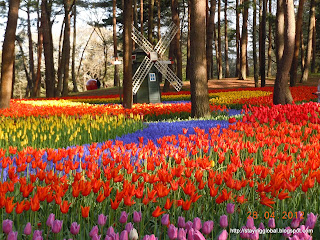
Tamago no Mori Flower garden had about 170 varieties of tulips blooming in all colours. 


The place looked like a multicoloured carpet.


A replica of a Dutch windmill stands amidst the tulips, giving visitors the feel of strolling in Holland’s Keukenhof gardens.  


Many other flowers were also blooming in the park.

Kominka is a recreation of an old house. 
It has exhibits used in daily life in countryside homes and is truly educational for schoolgoing children.


Giant carp streamers called "Koi no bori" which are hung during Children's Day were flying on a high pole outside the Kominka.

A lake known as “West Lake” and a water stage stand close to the Nishiguchi ( west gate) of the park.
The seaside park is a good place to visit for a day trip with family or friends.

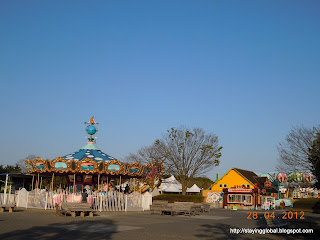
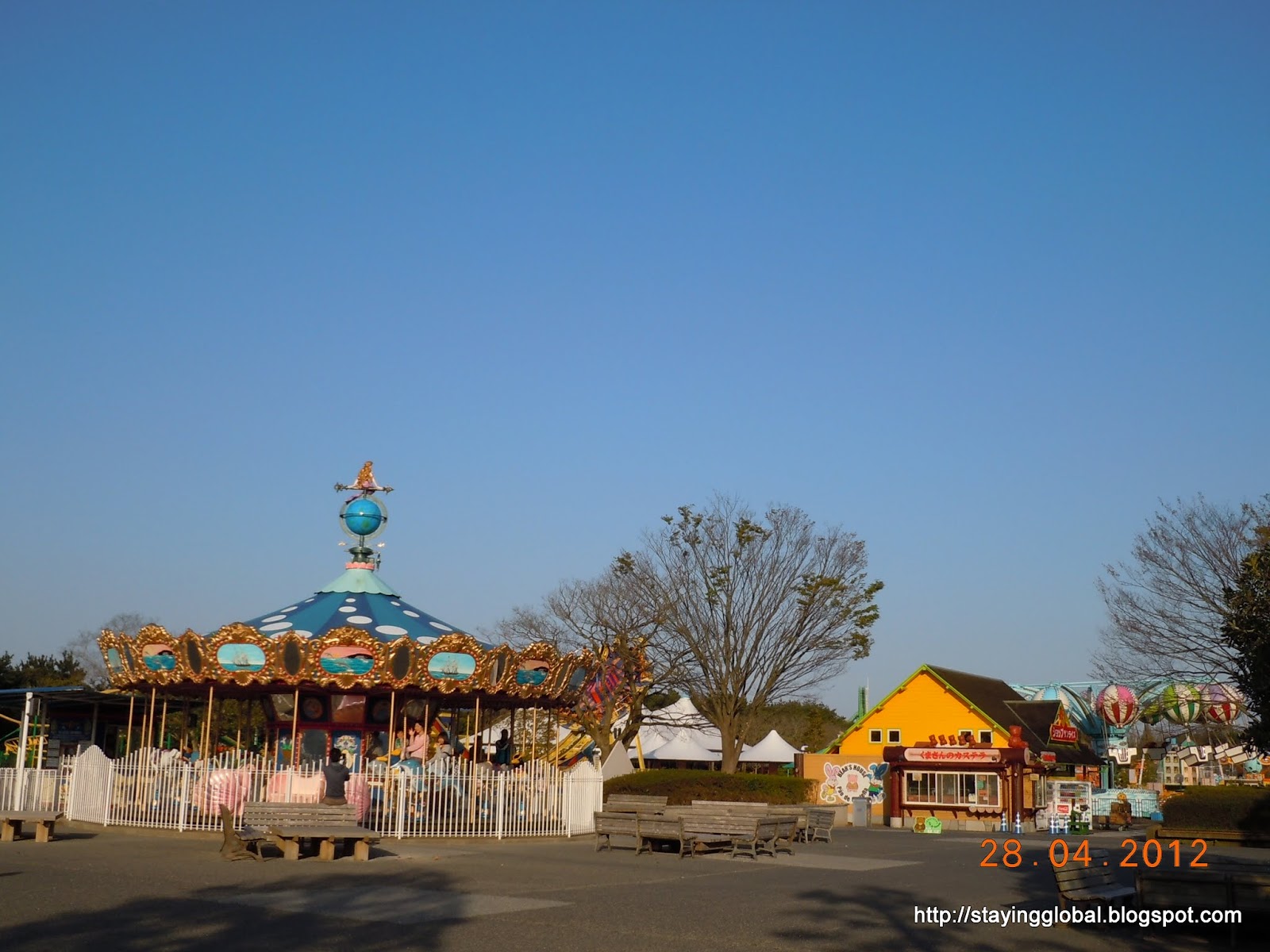
The park has an amusement park titled “ Pleasure Garden” which has many kinds of rides and shows. 


Separate tickets are required for the rides.

A play area is available near the Tamago no Mori flower garden where kids can play for no extra charge.  
 The seaside train is popular among visitors as you can hop on and hop off on it as often as you like as you explore the Park’s extensive area. The one day train pass comes for a fare of 500 yen. The entire route takes about 40 mins with the train stopping at 10 places.

Bicycles can be rented at various places in the park for fee of 300 yen ( Adults) and 200 yen (children) for 3 hours. Additional 50 yen is charged for every 30 mins thereafter.

A barbecue area amidst shady pine trees is a perfect spot for a weekend barbecue. Reservations are necessary (029-265-9002). Grilling equipment is also available.

Address: 605-4, Mawatari Aza, Oonuma, Hitachi naka city, Ibaraki prefecture.

Phone: 029-265-9001

Opening Hours: 9:30-17:00 hrs (closes early in winter)

Closing days: Monday ( Tuesday if Monday is public holiday)

Entrance fees: 400 yen for Adults
                       200 yen for Senior citizens
                       Elementary and Junior High school students: 80 yen.
                       Children under 6 free

(Printed English guide and map available at entrance)
   
Parking : Ample space available. Normal car 500 yen for one day parking.

Hana Matsuri- Celebrating Buddha's Birthday


Gautama Buddha, was born in 563 BC in the gardens of Lumbini, a city in Nepal to the Indian king Shuddhodana and his wife Queen Maya. He was known as Prince Siddhartha and led a prince’s life, married Princess Yashodhara and had a son Rahul. At the age of 29, while on a trip in his kingdom, he was deeply moved by the sights of poverty and illness of his subjects and he renounced his princely life to lead the life of a mendicant. At the age of 35 he attained enlightenment while meditating under a Peepal tree in the Indian city of Gaya. He came to be known as Gautama Buddha, the Awakened one and his preachings came to be known as Buddhism and his followers Buddhists. Buddhism then spread to various countries in East Asia and the local influence led to the development of various branches of Buddhism.

Buddhism came to Japan through China and Korea somewhere in 6th century AD. I have written about  Buddhism's influence on Japanese culture and society earlier, so am not going in to the details this time.

Buddha’s birthday is celebrated in most east Asian countries on the 8th day of the 4th month according to the Chinese lunar calendar. As such the date varies every year. However, in Japan it is celebrated either on the 8th of April or 8th of May. Japan follows the Gregorian calendar and the fourth month of the Chinese lunar calendar is translated to either April or May and hence either of these two dates are chosen by the Buddhist temples in Japan to mark Buddha’s birthday. The first celebration was reportedly held in 606 in Nara’s Asuka-dera.

Buddha’s birthday is known by the name of Hana Matsuri, which literally means “Flower Festival. Perhaps this is due to the fact that the day falls in spring, a season when a variety of flowers are blooming all over Japan. The celebration is known by a variety of other names – “Kanbutsu-e”, “Goutan-e”, “Busshou-e”, “Yokubutsu-e”, “Hanaeshiki-e” etc. Buddha’s birthday ,however, is not a national holiday in Japan and is only marked by rituals and ceremonies in Buddhist temples.

Today I attended the Hana Matsuri at my daughter’s kindergarten. She attends a kindergarten which is managed by a Buddhist temple in Iwaki. It was an interesting experience for me. The children arrived at the temple and prayed. The priest then addressed the gathering , explaining the significance of the day.  

They then changed into colourful attire, not the regular kimono’s but dresses which are usually worn by priests and shrine maidens. 

After this they performed a dance in front of the temple.
 After the dance, they were led to a small adjoining building, which had a small prayer hall with an altar.
 In front of the altar , small flower decorated altars, known as “ Hana mido” were placed.

Inside the Hana-mido, small statue of Buddha was placed in  a shallow metal bowl. The statue represents the infant Buddha. It is believed that immediately after his birth, Buddha raised and took seven steps forward and while pointing his right hand to the heavens, he is said to have proclaimed – “Tenjou tenga yuiga dokuson” which means  “ I am honoured in heaven and on earth”. It is also believed that the infant Buddha was sprinkled  with perfume by the dragon kings “Ryuu” and also a gently perfumed nectar rain had bathed infant Buddha. As a re-creation of these beliefs, the Kanbutsu-e ceremony was performed wherein the children poured “Ama-cha” a sweet tea prepared with hydrangea leaf.
After this ceremony, the children posed for a commemorative photograph in their colourful attire.


Wednesday, April 11, 2012

Hitachi: Kamine Park and Zoo

Our recent visit to Hitachi’s Sakura Matsuri and Furyu mono was combined with a visit to the nearby Kamine park. Kamine Park attracts lot of visitors during the Cherry Blossom season.
Along with Juo Panorama Park and Heiwa Dori, Kamine Park contributes to Hitachi’s place as one of the 100 most famous cherry blossom spots in Japan. Night time illumination of cherry trees in the park attracts lots of visitors during the Cherry blossom season. Our visit last weekend was a bit too early to view blossoms. 
A lone cherry tree had blossoms while the others were full of buds, ready to bloom. 
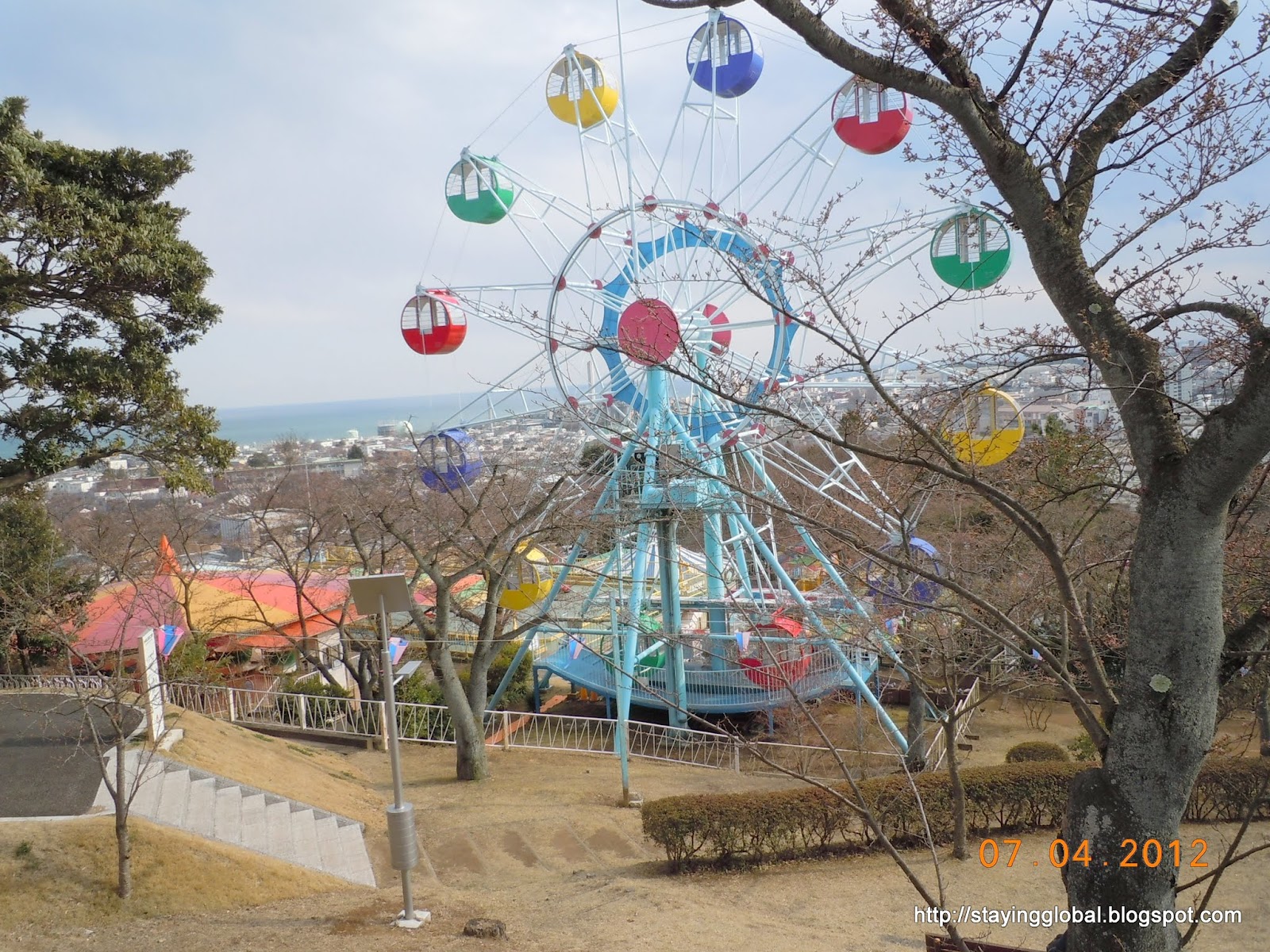
Kamine park is a large public park in Hitachi city, overlooking the city and the Pacific ocean. Kamine park is home to 2 amusement parks and a zoo within its 150,000 sq meter grounds.The Masashi Yoshida musical memorial hall and Museum is also located within the Kamine Park.
The amusement parks have various rides catering to children and adults of all ages. One park named  "Children's Playground" has rides more suitable for children . 

The other park "Leisure Land" has roller coaster and other rides which are suitable for adults.
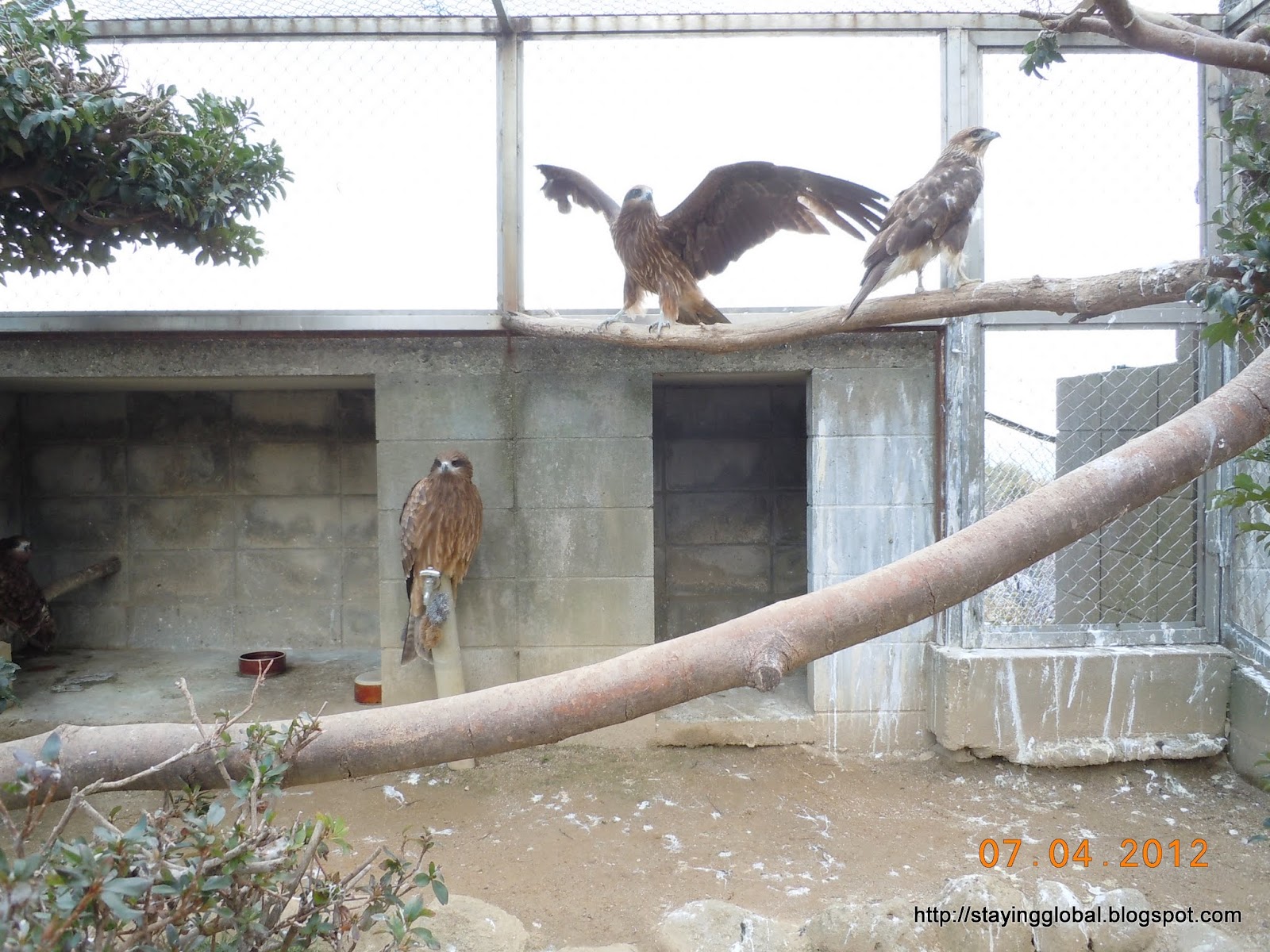
Kamine park zoo is a nice place to visit especially when accompanied by kids.
The zoo is home to a variety of animals and birds including Elephants, Penguins, Monkeys, Deer, Bear, Gorillas, Lions, Tigers, Rhinoceros, Hippopotamus, Flamingos, Zebras, Giraffes . Funny as it may sound Donkeys and Sheep also find a place in this zoo.     


Visitors can play with Rabbits and Marmots in the small petting area.

An observation deck higher up in the park offers a panoramic view of the city and the Pacific Ocean. 

Few "Love-locks" can be seen on the railings of the observation deck. 
Address: 5-5-22 Miyato-cho, Hitachi-shi, 317-0055, Ibaraki Prefecture

Phone: 0294-22-4727

Entrance:  Park: Free
                Zoo: Adults 500 yen, Children: 100 yen
                Amusement Park: Varies as per rides 

Parking: Free car parking available