Frankly speaking I am not sure how to classify this post - Hanami or Momijigari. To put it simply, Hanami is Blossom Viewing, a popular activity in spring and Momijigari is Foliage viewing, a popular activity in autumn. Confusing isn't it? Read on !
Of the 100 odd varieties of Cherry Blossoms in Japan, one variety blooms twice in Spring and again in Autumn. Not a commonly found variety, this kind of Cherry blossom is called Shikizakura or 4 season Cherry Blossom. Since it starts blooming somewhere around October, it is also called as Jugatsuzakura- simply translated to October Cherry Blossom !
There are very few places in Japan where visitors can view both Cherry blossoms and Autumn Foliage at the same time. We visited one such place last weekend.
Obara is a town forming part of Toyota city in Aichi prefecture and is roughly an hour's drive from Nagoya city. Obara is well known for its widespread Shikizakura trees- numbering about 10000 !
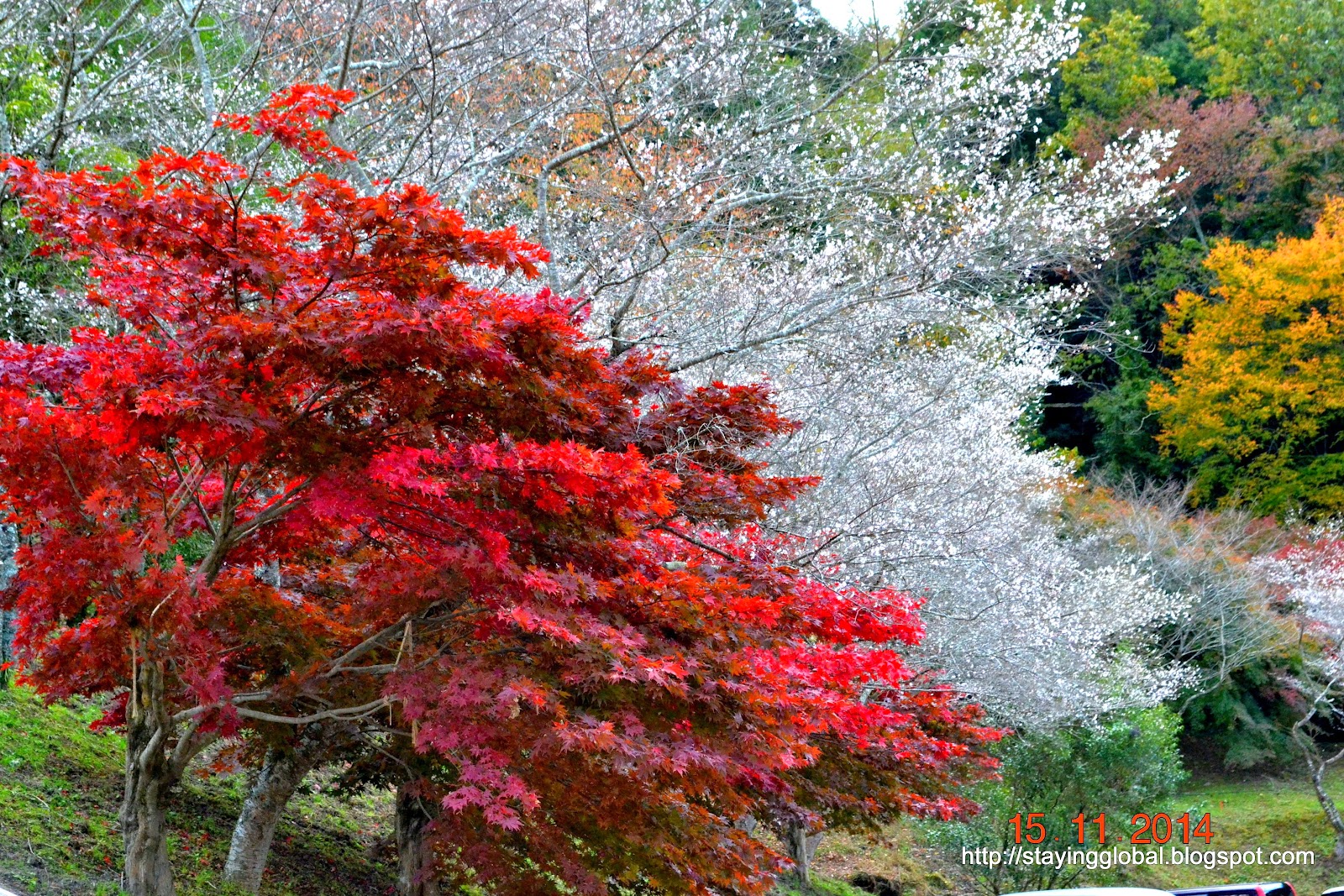
The white cherry blossoms against the backdrop of red maple leaves are a sight to see.
No wonder Obara attracts lots of tourists during the month of November.
Obara Fureai Park and Senmizakura Koen are the two popular spots to view the best Shikizakura and Momiji in Obara.
Address: Aichi Prefecture 470-0531, Toyota shi, Obara cho. Obara Fureai Koen
Phone: 0565-65-3808
Parking; Paid parking available near Obara Fureai Park
Obara Tourism Website (English) : Click here
Japan's cherry blossoms or Sakura, need no introduction. This year was our fourth cherry blossom season in Japan and as always, this time too we had our own hanami trips and hanami parties. Having moved to Nagoya last year, this was our first cherry blossom in central Japan. We visited Okazaki Castle, near Nagoya , a popular spot for cherry blossom viewing and also visited some popular places in Nagoya. This time, I am not going into the details of how people in Japan enjoy Cherry Blossom season and what is so special about this season since I have written about it earlier. This time, I am going to write about the various types of Cherry Blossoms, that make this season special.
Cherry Blossom or Sakura is the most famous of the blossoms that herald the arrival of spring. I was surprised to learn that there are over a hundred varieties of cherry trees - both wild and cultivated. The varieties differ in many characteristics - colour, number of petals, flowering period. etc. Most cherry blossoms have 5 petals but some varieties can have up to 100 petals. The cherry blossom varieties with more than 5 petals are classified as Yaezakura.
The most popular and common variety of Cherry Trees is the Yoshino Cherry Tree.
Blossoms of this tree have 5 petals and are mainly white with a tinge of pink. The leaves of these trees do not appear till the flowers begin to fall off. Huddled together in bunches, these blossoms are especially spectacular during their peak blooming period.
The reason for the large number of Yoshino Cherry trees can be attributed to its large scale cultivation during the Edo Period.
While Yoshino Cherry Trees are the most commonly cultivated cherry trees, the Yamazakura Cherry Tree is the most common wildly growing cherry tree.
Their appearance is slightly similar to the Yoshino Cherry tree but the petals are slightly smaller and the pinkish tinge is slightly darker. Another aspect in which it differs from the Yoshino cherry tree is that its leaves appear around the same time as the blossoms.
Another spectacular variety of Cherry Blossom is the Shidarezakura Cherry Tree, referred to in English as the Weeping Cherry tree.
These trees have drooping branches and people are especially fond of these cherry trees, thanks to their spectacular appearance.
Most Shidarezakura trees have blossoms with five petals. Shidarezakura trees having more than five petals are called Yaeshidarezakura. The blooming period of both these varieties differ from each other. One of Japan's most famous Cherry trees, the Takizakura of Miharu in Fukushima Prefecture is a Shidarezakura tree.
The earliest blooming cherry trees are mostly the Kanzakura cherry trees.
These are relatively less common and can be seen only in small neighbourhood parks or in private gardens. Usually when the bloom, people regard it as the arrival of spring.
Another early flowering Cherry tree is the Kawazuzakura Cherry Tree.
The flowers are usually pink in colour and have 5 petals. Like the Kanzakura cherry trees, these too are relatively less common and can be found mainly in public parks. These trees get their name from the Kawazu town in Izu Peninsula where they are said to have originated and are still commonly found there.
Another not so common variety of Cherry tree is the Kanhizakura Cherry Tree.
Mostly found in tropical climates, these cherry trees are more common in Okinawa in southern Japan and said to be native to Taiwan. These too bloom early and have dark pink to red bell shaped flowers.
One of the most common Yaezakura cherry trees is the Kanzan Cherry Tree.
These blossoms are usually light pink in colour and can have up to 30-50 petals. The leaves begin to appear before the blossoms fall off.
The Fugenzo Cherry Tree is another yaezakura cherry tree with flowers similar in appearance to those of the Kanzan cherry tree.
These flowers too have 30-40 petals, however the flowers are almost white when they blossom and gradually turn pink to dark pink as they mature. This is a late blooming variety of sakura.
Another late blooming variety is the Ichiyo Cherry tree.
These light pink flowers are smaller and have about 20-30 petals.
Kikuzakura Cherry Trees have by far the most different looking variety of cherry blossoms.
With over 100 petals, these cherry blossoms actually resemble the chrysanthemum flowers.
The flowers and leaves of these trees appear almost around the same time.
But Cherry blossoms are not limited to only spring. There is another variety of cherry blossoms, the Jugatsuzakura, which blooms in Autumn.
The name literally means October cherry, in reference to their blooming time. The flowers are small and only a few flowers appear on a tree.
The yellowish coloured flowers with 10-20 petals belong to the Ukon Cherry Tree. These too are a late blooming variety.
Another late blooming variety is the Shogetsu Cherry Tree. Its flowers are white and have about 20-30 petals.
Some varieties of Cherry Blossoms are white when they begin to bloom and turn pink later.
Trees like the one in the above picture are a common sight. the lower branches are covered with white coloured blossoms while the upper branches are covered with dark pink blossoms.
The blooming period of Cherry blossoms differs from region to region. The first blossoms appear in southernmost Japan's Kyushu as early as late January moving gradually to Hokkaido in northern Japan towards mid May. The blossom season is also very short lasting just a few days or at most a week long. Rain and winds also play a big role in how long the blossoms will last !
When blossoms first appear, they are referred to as "Kaika" while the full bloom is referred to as "Mankai". Some other words that are used when referring to blossom viewing are "Tsubomi" meaning the blossoms are still in the bud stage and have not yet opened up while "Migoro" is when the blossoms are at their best viewing time.
Last weekend we visited the Okazaki Castle. It was yet another Castle visit, something that we have been doing a lot since moving to Nagoya. But this time the main purpose of the visit was to enjoy the Sakura.
Okazaki castle is a castle in the city of Okazaki, less than an hour's drive from Nagoya. The castle was first constructed by Saigo Tsugiyori in 1455 and was captured by Matsudaira Kiyoyasu in 1524.
The castle is important in Japanese history as the birthplace of Tokugawa Ieyasu, the founder of the Tokugawa Shogunate and the person credited with unifying Japan. The castle is regarded as the cradle of the Tokugawa Shogunate.
A bronze statue dedicated to Tokugawa Ieyasu stands in the castle complex.
Tokugawa Ieyasu was born in the secondary citadel of the Okazaki castle on 26th December 1542. After birth he was named Matsudaira Motoyasu, the grandson of the powerful feudal lord Matsudaira Kiyoyasu. His initial years were very difficult since he almost lived the life of a hostage after the Okazaki castle was lost in battle to the Imogawa clan. Perhaps the difficulties faced during his early childhood made him the powerful hero that he went on to become in later years. Beginning with his victory in the Sekigahara battle, he won many battles and succeeded in unifying the whole country and became Japan's first Shogun. The Shogunate founded by him lasted about 300 years. He succeeded in capturing the castle in 1560 and lived here till 1570 when he moved to Hamamatsu, leaving his son Nobuyasu incharge. With the movement of the capital to Edo (present day Tokyo), Nobuyasu left the castle in 1590, handing it over to the Tanaka clan. During the Edo period, the castle town thrived owing to its location along the Tokaido Highway, the major road connecting Kyoto and Edo. The castle changed hands between the Honda, Matsudaira and Mizuno clans till it was taken over by the Meiji Government in 1869. In1873, the castle was demolished and land was sold off.
The current castle was constructed in1959 to boost tourism.It was reconstructed in 1982. It is considered to be one of the 100 Fine Castles of Japan.
The current castle, the Donjon, is a ferro-concrete structure which has three roofs and is five storied. Original artifacts, armour and weapons are exhibited inside the castle.
A Tablet dedicated to Tokugawa Ieyasu near the castle entrance.
The shrine adjacent to the castle's main keep, the Donjon.
The area surrounding the castle is now a park, the Okazaki Park which is famous for its Cherry Blossoms and Autumn Foliage.
Wisteria and Azaleas in the park also attract large crowds.
Many things associated with Tokugawa Ieyasu's life and early childhood can be seen in the castle complex. For instance this well which is located on the castle grounds.
It is said that water from this well was drawn for Tokugawa Ieyasu's first bath after birth.
This is the "Enazuka", the burial mound for the umbilical cord of Tokugawa Ieyasu.
This was relocated to its current location from elsewhere on the castle ground.
Red bridge across the moat surrounding the castle.
A small clock tower also stands in the castle park.
The Ieyasu and Mikawa Bushi (warrior) Museum in the castle complex.
Statues in the Castle complex.
A Noh theater and teahouse also stand in the castle park.
A rock garden and waterfall in the castle complex.
A Karakuri mechanical puppet show also takes place at specific times.
A special song and dance show was being held on the day we visited.
The programme featured a group of people from the age group preschoolers to senior citizens who gave spectacular performances of Japanese music and dances.
A floral clock in the Okazaki park.
This weekend, was the first weekend of the Cherry Blossom season of 2014. The sight of the blossoms was breathtaking.
The castle and its surrounding riverbanks were crowded with locals and visitors enjoying the Hanami.
Food stalls and shops selling toys and local products gave the area a typical "matsuri" look.
"Funa asobi" is traditional boating in rivers or canals bordered by Sakura trees and few people were also enjoying boating in the river.
Some were enjoying picnics or having barbecue parties with families and friends. Overall the entire area had a festive look.
Website: http://okazakipark.com/
Address: 444-0052, Aichi Prefecture, Okazaki shi, Kosei-cho, Okazaki Koen
Phone: 0564-22-2122
Admission Fees: Castle : Adult- 200 yen, Children-100 yen
Museum: Adult 350 yen, Children- 200 yen
Castle and Museum: Adult 500 yen; Children 270 yen
(Group discount available)
Opening Hours: 9:00 - 17:00 hrs
Closing days: 29th December to 1st January.
Parking: Paid parking available.
 Of the 100 odd varieties of Cherry Blossoms in Japan, one variety blooms twice in Spring and again in Autumn. Not a commonly found variety, this kind of Cherry blossom is called Shikizakura or 4 season Cherry Blossom. Since it starts blooming somewhere around October, it is also called as Jugatsuzakura- simply translated to October Cherry Blossom !
  There are very few places in Japan where visitors can view both Cherry blossoms and Autumn Foliage at the same time. We visited one such place last weekend.
 Obara is a town forming part of Toyota city in Aichi prefecture and is roughly an hour's drive from Nagoya city. Obara is well known for its widespread Shikizakura trees- numbering about 10000 !
 The white cherry blossoms against the backdrop of red maple leaves are a sight to see.
  No wonder Obara attracts lots of tourists during the month of November.
  Obara Fureai Park and Senmizakura Koen are the two popular spots to view the best Shikizakura and Momiji in Obara.


