Pages

Wednesday, September 14, 2011

Tsuchiyu


Tsuchiyu is an Onsen town in Fukushima prefecture. The foot-baths here are quite popular and that is what drove us to the town. 
The “Tsuchi-yukko” footbath is located in the Higashi Karasugawa Shinsui Koen park. When we visited, the entire area was covered with snow.
A lone waterfall in the distance was what we saw in the park
Another foot bath called “Tsuchi no Yubujye” is at the foot of the Tsuki No Yu Hashi Bridge.  The Arakawa O-hashi Bridge with Kokeshi dolls standing on both ends of the bridge is a pretty sight.
The town is also famous for the Kokeshi dolls and ranks among the three major production sites of Kokeshi Dolls in Japan.
We saw many Kokeshi dolls on display in the town.
Even the town's symbol is apparently the Kokeshi doll going by the manhole covers.
The town is also popular for the spring blossom and autumn foliage views. 

Address: 1, Kaminomachi, Tsuchiyu-Onsen, Fukushima, Japan

Phone: 024-595-2217

Parking: Limited


Tuesday, September 13, 2011

Exploring Aizu -Tsurugajo Castle - Aizu Wakamatsu

My last post about Aizumura made me realise that I have not written much about our travels in the Fukushima Prefecture. So I have decided to continue with a series of posts on the Fukushima region. 
My introduction to Aizu Wakamatsu town was partly due to the fact that it was the lone entry representing Fukushima prefecture in the Lonely Planet- Japan edition that I had purchased before moving to Japan. Fukushima has a lot to offer and definitely its tourism potential has been highly underrated. After the Great East Japan Earthquake and the Nuclear crisis, I see a far lesser chance of this fact changing any day soon.


Aizu Wakamatsu is said to be the oldest city in Fukushima Prefecture dating back to 1000 years ago. The old castle town earned popularity due to the tragic role it played during the Boshin War of 1868. The Boshin Civil War resulted in large scale deaths and the worst tragedy was the mass suicide committed by the Byakkotai . They were a group of 20 teenage Samurai boys who were assigned the task of guarding the Inawashiro pass. While returning to the castle, they saw white smoke rising from the direction where the Castle stood and they assumed that the Castle had fallen to the enemy. Preferring death over capture by the enemy, they attempted mass suicide, 19 died with just 1 survivor. A memorial for these brave warriors is located on the Imoriyama hill.  

Aizu’s most prominent destination, the Tsuruga-jo Castle was built in 1384. 

It has changed many hands since its construction and had been destroyed during the Boshin Civil War. It was one of the last strongholds of the samurai’s loyal to the Shogunate.The current castle was reconstructed in concrete in 1960 and the last renovation was completed in 2010-11.

When we visited the castle, a young man in Samurai costume stood at the entrance of the castle.

Walking further, we reached the Castle grounds, which unfortunately do not classify as a garden in the real sense. It is just a wide expanse of well tended lawns.

Tsuruga-jo is a five storeyed castle. 

On the first floor, there are displays of  some history of the castle town and a collection of armor and weapons. Other floors have local crafts, information about the building of the castle,life in old days and the history of the Boshin War.


There is a nice observatory on the fifth floor where you can get an excellent view of the surrounding city and Mt. Bandai. 

The castle's exit takes you through the gift shop and further ahead to a long connecting passage with another tower that has displays on life in the castle and it's defenses.
Within the castle grounds is the Rinkaku Tea House, which was used by the feudal lords to hold tea ceremonies. Today for a small fee, visitors can walk around and experience a tea ceremony. Tea and snacks are also sold here. 


The Tsurugajo Park surrounds the castle. The well tended lawns and cherry trees make it a particularly attractive sight during the Sakura season in Spring, when it is flocked by visitors. 

The surrounding moat and stone walls, previously serving a security purpose, today remain a reminder of the glorious past of the castle.

Opening Hours: 8:30-17:00.

Open : 365 days a year

Admission fees:  400 yen (Castle only): 500 yen (Castle and Teahouse)
                        
Address: 1-1, Oitemachi, Aizu Wakamatsu City, Fukushima Ken, Japan 965-0873

Phone: 0242-27-4005

Website: http://www.tsurugajo.com/e/turugajo.html (English) 

Monday, September 12, 2011

Exploring Aizu : Aizumura

On one of our trips in the Bandai-Aizu region, we came across a huge statue on a hillock at a distance. Curious to see what it was, we drove in the direction and reached the Aizumura Park. We purchased our entrance tickets and walked in to see a smaller version of the statue near the entrance. 

A small path ahead led us to a castle like gateway beyond which stood the statue. This castle like gate named as Otemon is supposed to have been modelled after the Nijo castle of Kyoto. 

The statue that had attracted us to the park was that of "Aizu Dai Jibo Kannon", a female form of Buddha and is depicted carrying a small baby in its arms. The Kannon is the Goddess of mercy. The statue is 57 metres high and was completed in August 1987. The statue is actually a tower and about 275 steps lead to a viewing point, which is actually through the Kannon's eyes! 

About 10,000 small golden statues of the Kannon can be seen inside the statue. A golden statue at the base. 

An aerial view of the park below as seen from the foot of the Kannon statue.

The park is actually spread out over 6 acres and has a well tended garden with a Cherry Blossom path, Pines and other flowering plants.

Spring and Autumn appear to be the better seasons to enjoy the flora, but we visited in summer and had to be content seeing the greenery and a few flowers. 

Walking down one of the several paths, we came to a pond, which is home to maybe thousands of carps. 

Sensing any human presence nearby, the hungry carps crowd near the shore for food. 
Crossing the red bridge we reached a hall and a watermill.

 A short walk ahead is a statue of a reclining Buddha. 

Moving ahead we saw a small wooden shrines dedicted to Jizo. 

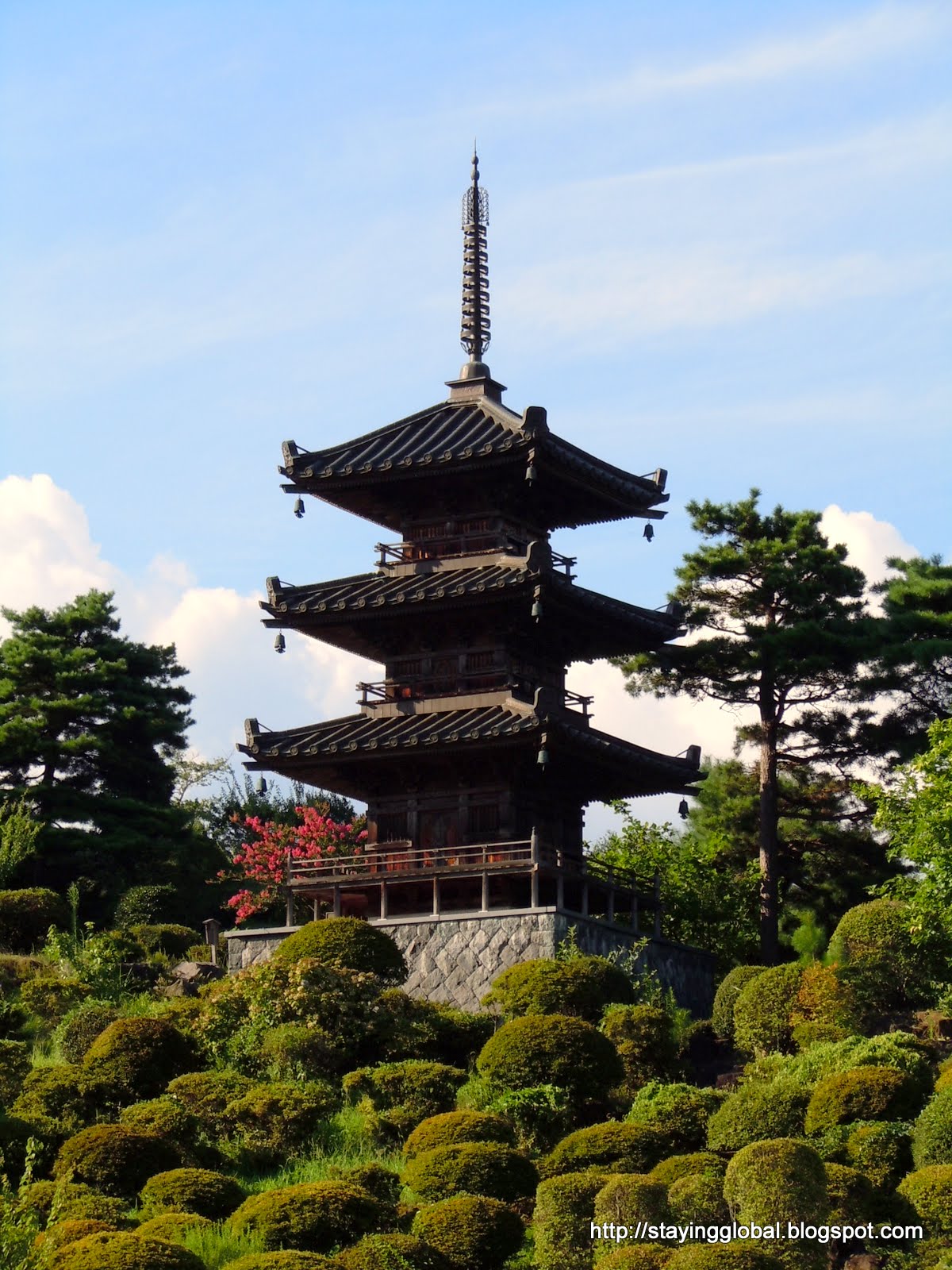
A three storeyed wooden pagoda stood ahead.

It seemed dwarf-like with the Kannon statue in the backdrop.  

For those unwilling to walk the length of the park, an excursion car is available at regular intervals.

(In the aftermath of the Great Eastern Earthquake and the following nuclear crisis, this region has had some impact of the nuclear radiation. Please check with local sources for relevant safety advisories.)

Visiting the Numanouchi Benzaiten Shrine

Iwaki city is a peaceful city by the Pacific Coast.The city is not a major tourist destination. However there are  few places which are worth a visit on weekends when you don't want to travel far. One such place we came across was the Numanouchi Benzaiten Temple. The temple is located on a small hillock and is hidden behind trees. It is not easy to locate the temple without a car navigation system or without asking for directions.

 The Numanouchi Benzaiten temple is dedicated to "Benten" or "Benzaiten", the female deity of Fortune, water, music, poetry, arts and learning. It is believed that Benten is the Japanese name for the Hindu goddess of learning, Saraswati.  Benzaiten is the only female deity among the "Shichi Fuku Jin" the seven lucky gods.  A carved stone depicting the "Shichi Fuku Jin" at the temple. In this Benzaiten can be seen seated with a "Biwa" or lute in her hand ( second from right).

The temple is said to date back to the 9th century, a fact perhaps evident from the weathered wooden structure.
The wooden temple building is engraved with wood carvings. 
It is also called Kashikonumadera because of the Kashikonuma pond located next to it. 
"Numa-no-uchi" means  house in the pond and this explains the meaning of the temple's name. 


It is said that giant eels and carps live in the Kashikonuma pond. These fish have been designated as living natural monuments. Visitors can purchase small packets of breadcrumbs for the fish.


The small wooden structure next to the pond has a colourfully painted roof depicting creatures from mythology.

The site of the old wooden structures amidst greenery and with a lake makes the place picturesque. 
  

Friday, September 09, 2011

For Love of Mushrooms

I have always loved Mushrooms and have enjoyed any form in which they have landed up on my plate. Unfortunately, most of the times the mushrooms are the button mushrooms which have been artificially cultivated. This eliminates the fear of eating a toxic variety of naturally grown mushroom. However the farm grown mushrooms do not have the exotic taste of the naturally grown mushrooms.I had eaten a few of the exotic varieties of mushrooms during my stay in South Korea. But the variety of mushrooms in Japan is simply overwhelming. 

Mushrooms are called "Kinoko" in Japanese and are an integral part of Japanese cuisine. Mushrooms are served in both raw and cooked forms and are served in soups, salads, in rice dishes, in sushi, grilled or sauteed, with noodles, in nabe dishes, in stews or as tempuras. 

Shiitake mushrooms remain one of Japan's more popular varieties and has found a place for itself in South East Asian cuisine. It has the tendency to absorb flavours and its chewy texture makes it an ideal for soups, stews and warm salads. The dried Shiitake mushrooms are preferred and tend to be priced higher than the fresher variety. In the cold winter months, dried Shiitake is abundantly used, making up for the scarcity of certain types of vegetables. 

Enoki mushrooms are actually a cluster of mushrooms. Initially I had mistaken it for a small bunch of pearly white flowers! It owes its name to the Enoki tree where it grows. These days it is also cultivated in bottles or plastic bags. The naturally grown variety has a brownish tinge. Its clear and fruity taste make it a favourite in many Japanese dishes and it is usually served as a topping over soup or salads. It is also rolled up in some varieties of Sushi or sometimes stir fried and tossed in  "Yaki-soba".      

Shimeji mushrooms are usually not eaten raw owing to its bitter taste. As such this is one variety which is served only in cooked form - mostly in soups and sometimes roasted. Strange as it may sound, the bitterness disappears with the cooking. It has a crunchy, nutty texture and is usually served in a nabe (hotpot) dish or is combined with seafood. It is reported to be a difficult variety to cultivate and some cultivation methods are said to have been patented! 

Maitake mushrooms are the fourth type of mushrooms which enjoy a special place in Japanese cuisine. They are regarded as the "king of mushrooms". These mushrooms grow in clusters, usually below Oak trees and are abundant in North eastern Japan. Maitake mushrooms are commonly used in cooking "nabe" (hot pot) dishes. It is also said to have medicinal properties and is used in traditional Oriental medicine. In case of Maitake, when shopping the golden rule to remember is - The smaller the mushroom, the easier to digest and the bigger the mushroom, the harder to chew. So pick your Maitake carefully. 

Tamogitake mushrooms are another variety of mushrooms which have medicinal properties. This golden oyster mushroom is generally grown on sawdust or straw and are said to be one of the easier to cultivate varieties. The flesh is thin and white and the taste is mild, with no odour. This makes this mushroom a easy to blend ingredient in many Japanese dishes.

Hiratake ,sometimes called Eringii, also found in Middle East and Europe, are common in Japanese cuisine. They are also called King Trumpet mushroom owing to its shape.These can be eaten raw or in cooked form. The taste changes when the mushroom is cooked. It is juicy and does not loose its colour or shape easily even after cooking. These are a personal favorite.

Matsutake mushrooms grow in abundance in North eastern Japan. These grow in the wild under trees, especially pine. Since they are mostly concealed under heaps of fallen leaves, they are hard to find and as such they are usually more expensive. It has a distinct pungent odor, making it a preferred variety in many Japanese dishes. These days, it is imported from China, Korea and North America, thereby making it costlier. 

No Japanese meal seems to be complete without the humble fungii finding its place on the table. When in Japan, enjoy your fungii.