Nagoya, an industrial city in Central Japan, is not on every tourist's itinerary when visiting Japan. However Nagoya is well known for a couple of things- its cuisine known as Nagoya Meshi, the hot and humid summer season and its place in history as a former Samurai district. Like Tokyo and Japan, Nagoya is an erstwhile castle town where the feudal lord resided in the Castle and his samurais lived in areas surrounding the castle. For over 200 years, Nagoya was the seat of the Owari branch of the powerful Tokugawa clan. Needless to say, Nagoya does have its share of historical spots that attract a fair share of tourists.
One such spot in Nagoya is Tokugawa-en, a garden well known for its scenic beauty especially in the colorful seasons of Spring and Autumn.
 The garden was laid out in 1695 AD around the retirement villa of Lord Mitsumoto of the Owari-Tokugawa clan.
 Originally the garden was spread out over 44 hectares of land complete with a large lake, the Ryusenko Lake, in the centre.

 Colorful koi fish swim in the Ryusenko lake.
 Some views of Tokugawa-en.


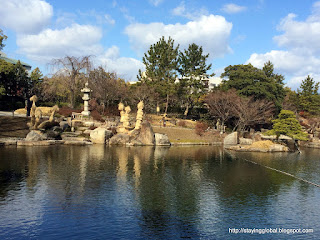 The garden has waterfalls, a tea house, wooden bridge, restaurants and flower beds.
One of the entrances to the gate is the Kuro-mon gate, the Black gate which dates to early 1900's and is said to have survived the bombings of WWII. A large part of the garden was destroyed in the WWII bombings and was reconstructed to its current form and opened to public only in 2004.
The garden is said to be spectacular in Spring and Autumn. Various kinds of flowers bloom in the garden through the seasons. I visited the park with my friends during the Peony festival.
 Many varieties of Peonies were blooming. Peonies. know as Botan in Japanese are seen as a symbol of good fortune, bravery and honor and have been depicted in traditional Japanese art, especially ukiyo-e paintings. Peonies were introduced to Japan from China and have been used in preparing traditional medicines. Perhaps due to these reasons, some varieties of Peonies are known as King of Flowers in Japan.
 The flowering pots had an interesting style- a straw canopy covered one side of the pot, perhaps to shield the flowering plants from rain and wind.
 Some of the peonies in the park
 Plum blossoms were beginning to bloom during our visit.
 Also on the grounds of the garden is the Tokugawa Art Museum which houses various exhibits and artifacts such as armors and swords, costumes, masks among other treasures. Visitors can choose to visit both the Garden and the Museum or just one of them. Combination as well as separate facility tickets are available.
Address: Aichi Prefecture, Nagoya 461-0023, Higashi ku, Tokugawa cho 1001
Opening Hours: Tokugawa Garden: 9:00-17:30 hrs
Tokugawa Art Museum : 10:00-17:00 hrs
Closed : Every Monday ( following day if public holiday falls on a Monday)
December 29-31 ; (Museum is closed also between Mid December- early January)
Entrance Fees: Tokugawa en Garden : 300 yen
Tokugawa Art Museum : 1200 yen
Combination ticket: 1350 yen
Parking: Paid parking available.
Official Website: www.http://www.tokugawaen.city.nagoya.jp/english/index.html
One such spot in Nagoya is Tokugawa-en, a garden well known for its scenic beauty especially in the colorful seasons of Spring and Autumn.


The garden is said to be spectacular in Spring and Autumn. Various kinds of flowers bloom in the garden through the seasons. I visited the park with my friends during the Peony festival.


Address: Aichi Prefecture, Nagoya 461-0023, Higashi ku, Tokugawa cho 1001
Opening Hours: Tokugawa Garden: 9:00-17:30 hrs
Tokugawa Art Museum : 10:00-17:00 hrs
Closed : Every Monday ( following day if public holiday falls on a Monday)
December 29-31 ; (Museum is closed also between Mid December- early January)
Entrance Fees: Tokugawa en Garden : 300 yen
Tokugawa Art Museum : 1200 yen
Combination ticket: 1350 yen
Parking: Paid parking available.
Official Website: www.http://www.tokugawaen.city.nagoya.jp/english/index.html


