Pages

Showing posts with label Yamanashi. Show all posts

Tuesday, October 02, 2012

Fuji Q Highland


Fuji Q highland is an amusement park located at the base of Mt Fuji in Fujiyoshida city, Yamanashi prefecture. The park is home to many roller coasters and thrilling rides and as such is counted amongst one of the most popular theme parks in Japan.
Fujiyama, at 79 meters high and a speed of 130 km/h is the park’s tallest roller coaster. 
Having opened in 1996, it was once the world’s tallest roller coaster.


It is still one of world’s tallest, fastest and longest roller coasters.

Eejanaika, at 76 meters high is a relatively new attraction having opened only in 2006. It is the second 4D roller coaster to be built in this world after X2 in California’s Six Flags Magic Mountain  but is higher and faster than X2. It’s seats can rotate 360 degrees forward or backward in a controlled spin.

Dodonpa, at 52 meters high opened in 2001 and has a speed of 172 km/h. 
It was once the world’s fastest roller coaster.

Takabisha, is the newest roller coaster in Fuji Q and opened in July 2011. 
It is the world’s steepest roller coaster, certified by the Guiness Book of World records at the time of opening.


It has a drop of 43 meters, speed of 100 km/h a freefall of 121 degrees and seven major twists and dark tunnels on its 1000 meter long track.

 The tracks look scary even when viewed from ground level!

Some other thrilling rides in the park are 
Tekkotsu Bancho


Tondemina,

Nagashimasuka, 

Great Zaboon

 Panic Clock


Mad Mouse
Most of the thriller rides and roller coasters have height restrictions and other restrictions regarding age and health. 


Thomas Land is a children’s amusement park area designed after Thomas the Tank engine theme. Most visitors seem to find this the most fun area in the park !
 Japan’s highest mountain forms a picturesque backdrop to most of the roller coaster rides in the theme park.


Access: 5-6-1 Shin-Nishihara. Fujiyoshida, Yamanashi Prefecture 403-0017 Japan

(The pictures in this post were taken by a friend during a recent visit to Fuji Q Highland. I am thankful to my friend for sharing these pics and experience with me and allowing me to use these for my blog.)

Friday, September 28, 2012

Fujiyoshida Sengen Shrine

On our way from Lake Yamanaka to Lake Kawaguchi, we stopped by the Fujiyoshida Sengen shrine.

The Fujiyoshida Sengen shrine is dedicated to Konohanasakuyahime, the Shinto deity associated with Mt Fuji. The formal name of the shrine is Kitaguchi Hongu Sengen Jinja which means North Entrance Sengen Main Shrine and the name derives from the fact that this is the Main Sengen shrine on the north side of the shrine. There are more than 1000 Sengen shrines dedicated to Mt Fuji across Japan, but the main deity of Mt Fuji is believed to be enshrined in the Fujiyoshida Sengen shrine. 
The shrine served as the focal point of Mt Fuji worship during the Edo period.

Traditionally, climbers would begin their Mt Fuji ascent after praying at the Fujiyoshida Sengen Shrine. The old trail begins from behind the Shrine’s main hall. A wooden trail behind the shrine marks the beginning of the traditional trail. 
Even to this day, few climbers, mostly those undertaking the climb as a pilgrimage begin their climb after offering prayers at the shrine. However, most climbers prefer to begin their ascent from one of the several 5th stations of Mt Fuji, Kawaguchiko 5th station being the most popular starting point. It is said that if the climb is begun from the Fujiyoshida Sengen shrine, it takes about 8-10 hours to reach the summit.

The shrine is surrounded by a dense pine and cedar forest. 
The path leading to the shrine is lined by stone lanterns on either side.

The large wooden torii gate of the Sengen shrine is over 18 m high and is counted amongst one of the largest wooden gates in Japan. 
According to tradition, the torii is rebuilt slightly larger, every six decades. Near the top of the Torii, a signboard reads "Sangoko Daiichizan", which translates to the highest mountain among three countries- Japan, India and China.

The shrine buildings are painted in red, as in most other Shinto shrines.

The main hall dates back to 1615 and the altar is decorated in ornamental style.  
Many murals and wooden masks adorn the walls and ceilings of the shrine. 
Three of the original cedar trees are believed to have survived over the centuries and these are adorned by the holy rope.

Fuji Five Lakes

Mount Fuji needs no introduction. It has always been a symbol of Japan till this day remains on every tourist’s list of must visit places in Japan. Mount Fuji’s near perfect conical shape is the result of its multiple eruptions and lava flows.

Mount Fuji’s multiple eruptions have also resulted in the formation of the Fuji Five Lakes, also known as Fuji-go-ko. Fuji Five Lakes is the area located around the base of Mt Fuji’s northern half and is located in Yamanashi Prefecture. In recent years, Fuji Five Lakes which form part of  the Fuji-Hakone Izu National Park, has become a much visited tourist attraction. The lava flows from Mt Fuji’s eruptions dammed rivers and resulted in the formation of these five lakes. All of the lakes are considered to be excellent fishing spots and have been developed into tourist spots atleast to some extent.

The Five Lakes that form part of Fujigoko are Lake Kawaguchi, Lake Yamanaka, Lake Saiko, Lake Motosu and Lake Shoji. All lakes also provide good views of Mt Fuji, on days when the sky is clear and weather is good. Spring and Autumn when the flora and foliage are at their best and most colourful are preferred seasons for visiting Fuji Five Lakes.

On our recent trip to the Fuji-Hakone area, we visited two of these lakes- Lake Yamanaka and Lake Kawaguchi. Our first stop was Lake Yamanaka. Yamanaka-ko as the lake is also known is the easternmost and largest of the five lakes. 
 Located at an altitude of 980 metres above sea level, it is also the third highest lake in Japan. The lake has a circumference of 13 kms and offers good views of Mt Fuji from its northern shore on clear days. 
However on the day of our visit, the sky was cloudy and as such we could not see even the slightest trace of Mt Fuji. 
Yamanaka ko is popular among visitors for Boating, fishing and other water sports and ranks as the second most developed of the five lakes behind Lake Kawaguchi.
In recent years Yamanaka ko is emerging as the most popular of the Fuji Five Lakes.

After visiting Lake Yamanaka, we drove up further to Lake Kawaguchi. On the way to Lake Kawaguchi, we briefly stopped at the Fujiyoshida Sengen shrine.

Lake Kawaguchi also known as Kawaguchi ko, is the most popular of the Fuji Five Lakes. This lake also has a circumference of 13 kms and this too offers good and unobstructed views of Mt Fuji on clear weather days and is a photographer’s delight. Most images and calendar pictures of Mt Fuji forming the backdrop of a lake are said to be taken from one of the shores of Kawaguchi-ko. 
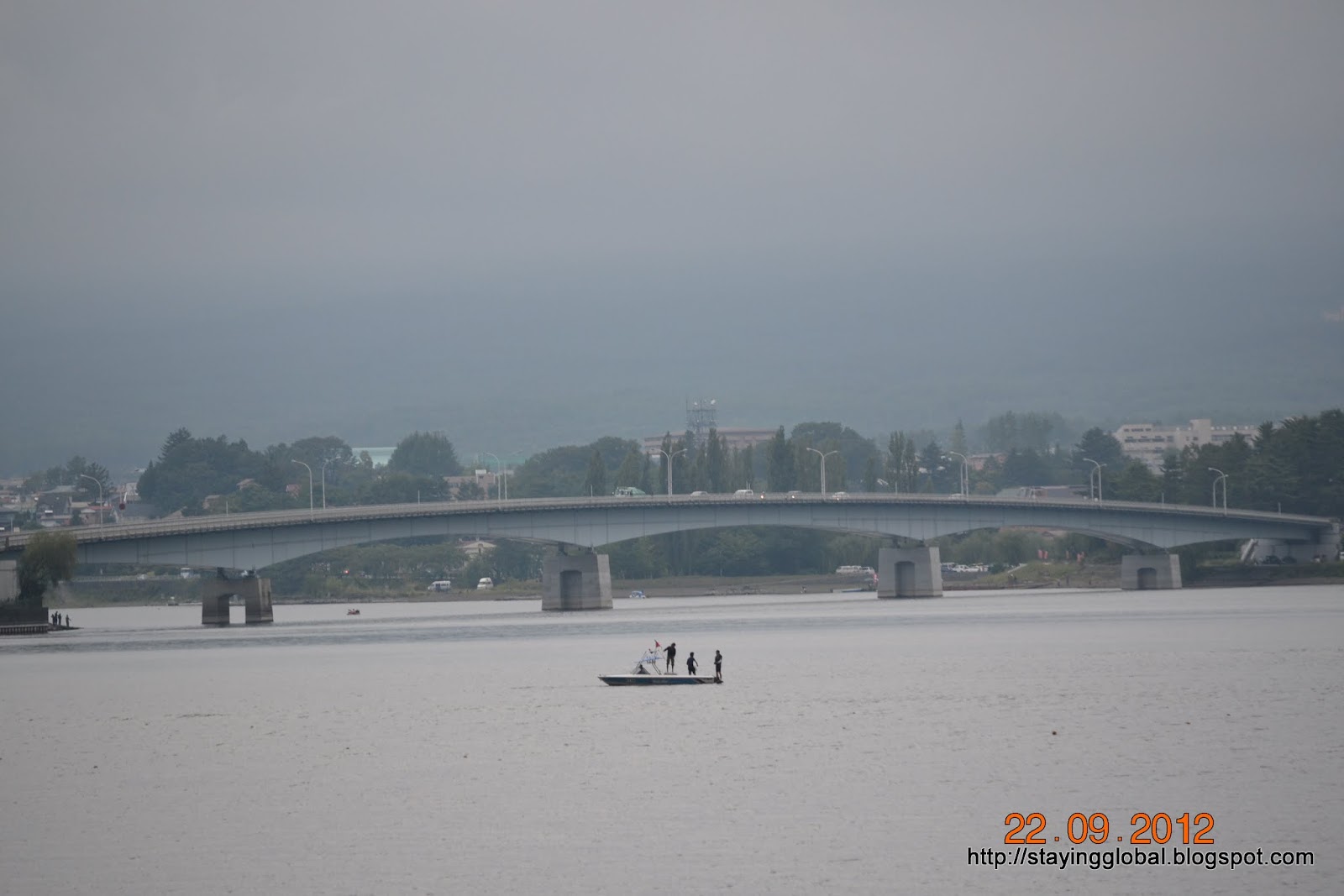
Unfortunately we visited the lake on a cloudy day and as such we could not view Mt Fuji. Kawaguchi is the only lake amongst the Fuji Five Lakes to have an island.
 Kawaguchi ko is the most developed of the five lakes and there is no dearth of hotels and other accommodation in Kawaguchi town which has turned to a popular holiday resort.
Visitors can indulge in various water sports at Lake Kawaguchi. The Subaru toll road which leads up to Kawaguchi ko 5th Station begins from close to the Kawaguchi IC. Kawaguchiko 5th station serves as a starting point for climbing Mt Fuji.

Lake Saiko, also known as Saiko-ko is located just about 1 km to the west of Lake Kawaguchi and thus is also called the Western Lake. The western side of Lake Saiko shares its banks with the Aokigahara Jukai forest. The lake has a circumference of 10.5 kilometers but the lake is not much developed. However, there are many camp sites located along the lake’s shores.

Lake Shoji, also called Shoji-ko, is the smallest of the five lakes wth a circumference of 2.5 kms. Rocks jutting out of the lake are remnants of lava flow and these days used by locals fishing in the lake’s water. Fishing and boating are popular outdoor activities at Lake Shoji.

The last of the five lakes is Lake Motosu, which at 140 meters, is the ninth deepest lake of Japan. Motosu lake along with Lake Saiko and Lake Shoji was formed by lava flowing through the area which is now Aokigahara Jukai Forest. The lava separated a large prehistoric lake in the area thus resulting in the formation of the three lakes. These three lakes are still connected by means of underground waterways and are also said to maintain the same surface level of 900 meters above sea level. The lake has a circumference of 13 kms .The picture of Mt Fuji on the 1000 yen note is said to be a depiction of the view of Mt Fuji from near Lake Motosu. The shores are not much developed barring few camping grounds.

The Aokigahara Jukai Forest is an expansive forest south of Lake Saiko which has a network of hiking trails and is reputed to be easy to get lost in. This area is also infamous as a suicide spot. Past lava flows have also resulted in the formation of several caves around the Aokigahara Jukai Forest. Three of the lakes – Ice Cave, Wind Cave and Bat Cave have become popular tourist destinations.

The main city in the Fuji Five Lakes area is Fujiyoshida city, which is also popular for the Fuji Q Highland. Kawaguchiko area also has a variety of museums like the Yamanashi Gem museum, Kawaguchiko Music forest, Kawaguchiko Museum of Art etc. Udon noodles are a popular delicacy from the region. 

Wednesday, November 17, 2010

Hakone

On the last leg of our Kyoto - Nara trip, we visited Hakone.

Hakone is a tourist destination which is popular among both Japanese and foreigners, the main reason being the proximity to Mt Fuji and Tokyo. Hakone-machi town is located in Fuji-Hakone-Izu National park and is centered around the Lake Ashi.
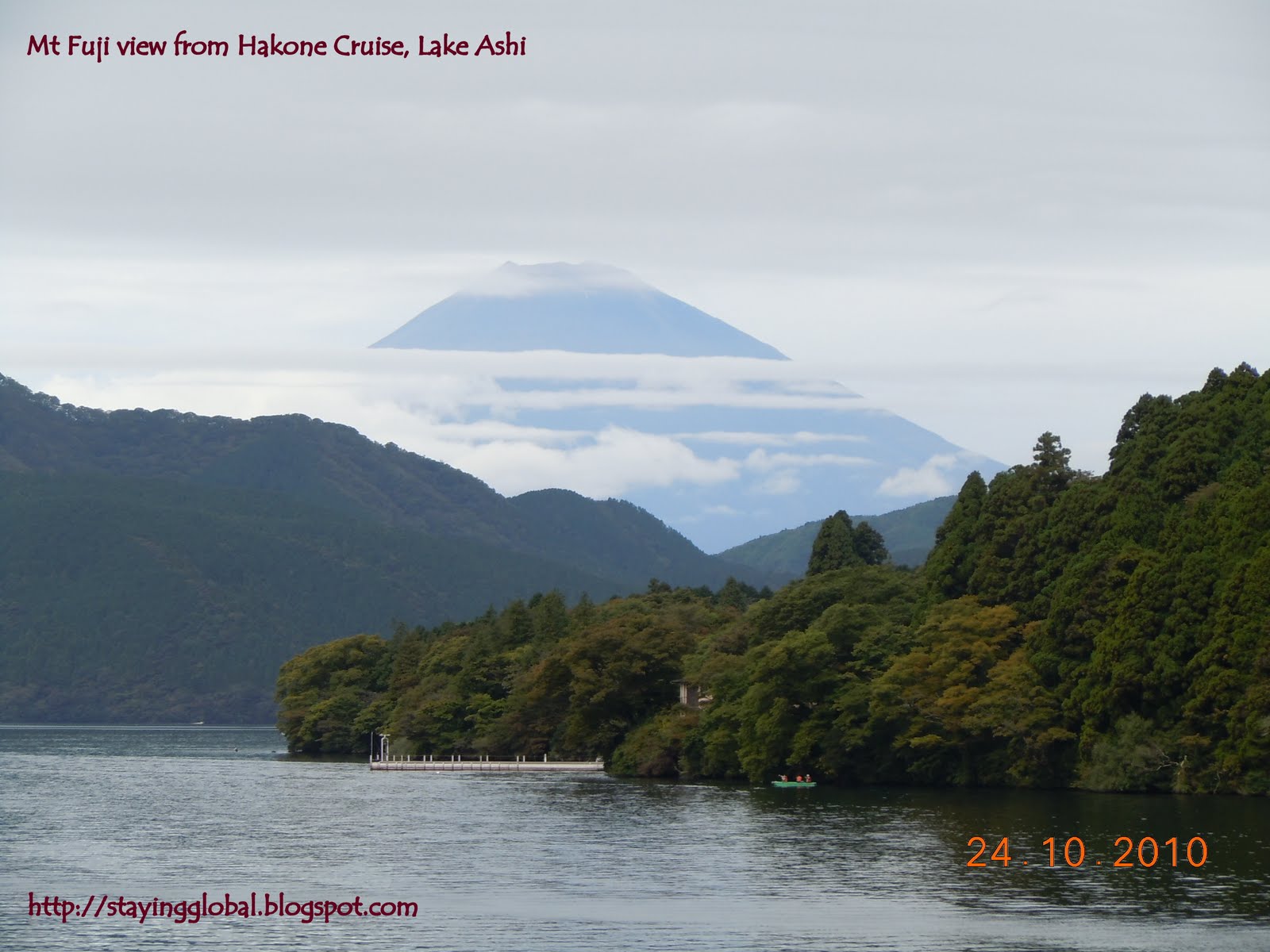
A good view of Mt Fuji and its reflection in the water on a clear day make Lake Ashi a popular destination. The scenery around is breathtaking. A cruise in Lake Ashi on the pirate boat is one of the most popular activity while in Hakonemachi.
The pirate boat can be kitschy and the so called pirates are only two pirate images placed on the upper deck. A person dressed in a pirate dress makes the rounds with a cameraman offering to pose with tourists for a souvenir photography. No doubt though that the cruise is the best way to view Mt Fuji and the surroundings on a clear day.
The torii of the Hakone Shrine in the lakewaters is a pretty sight.
 There are lots of museums and parks in and around Hakonemachi . There are onsens in the region especially near Hakone Yumoto.

However the most popular spot is Owakudani also known as the Great Boiling  Valley.
The Hakone volcano erupted over 3000 years ago and caused large scale destruction. The entire area is an active volcanic zone and sulphur fumes, hot springs and bubbling pools are found in plenty. 
Even today at times the volcanic outbursts are strong and hence the entire area is monitored for safety all round the clock. At times entry is restricted in case the volcanic gas density reaches alarming levels.The entire place smells strongly of Sulphur. A short trail dubbed “Nature research route” leads along volcanic area . 
 A popular delicacy at Owakudani is the “Kuro Tamago” or Black Egg also called Longevity eggs.  Eggs are boiled in sulphur pits and the egg shells turn black and the egg smells faintly of sulphur too. 
These black eggs are supposed to enhance one’s life by seven years. A pack of 6 boiled eggs costs 500 yen.
The popularity of the black eggs is evident from the long queues outside the Tamago Chaya where these eggs are sold. 
Since these eggs last for 4-5 days at normal room temperature, these are popular souvenirs among local Japanese.

There are boards all along which advise people not to stay in the area for too long as one can feel dizzy.
Most people prefer to take the cable car ride to Owakudani. It is an enjoyable ride which also offers some good views along the ride. Owakudani is also accessible by road. Lots of buses operate from various spots in the Hakone region to Owakudani. Car parking is also available at Owakudani though at times it can be crowded.

The ideal tour around the area is a Lake Ashi sightseeingcruise from Hakone to Togendai. The cruise begins from Hakonemachi-ko port and 10 minutes later reaches Moto Hakone-ko port on the way to Togendai. A 40 minute one way cruise costs Yen 970 for adults. The Hakone Ropeway operates between Togendai to Sounzan. Owakudani is approx 16 min ride from Togendai and  8 min ride from Sounzan.  The ropeway fare between Togendai and Owakudani is Yen 1020 for adults and Yen 510 for children. However the entire course by cruise, ropeway and back to Hakone machi takes about 3 hours. If  time is a constraint, driving up to Owakudani and back is the fastest way. On weekends though, the uphill drive can take a lot of time with slow moving traffic. The views along the road are nice too.
Hakone is accessible from Odawara by the Hakone Tozan line via Gora. From Gora, the Hakone Tozan funicular cable car provides access to Sounzan. The Romance car limited express train connects Shinjuku to Hakone Yumoto.

Owakudani :
Opening hours: 8.00-17.30 ( 17.00 hrs from December-March)
Phone No: 0460-84-5201
Entrance : Free

Lake Ashi / Hakone Sightseeing Cruise:
(Hakone-machi-ko pier)
Operating Hours: 9.30 to 17:00
Phone no:  0460-83-7550
Ample car parking (free) available near the pier