Pages

Thursday, December 16, 2010

Vending Machine Paradise

One of the first things that most foreigners notice when they land in Japan is the number of vending machines. The moment you arrive at Narita airport and make your way out to the arrival lounge or to the parking area, you notice vending machines. No wonder  at 1 vending machine per 23 people, Japan has the highest number of vending machines per capita !

Most common vending machines are those vending canned and bottled beverages. These vending machines are so common that not finding one every few hundred metres down a road seems odd. You can buy cola, green tea, Japanese O-cha, Milk tea, Coffee, Milk, juice, water just about anything.
Most drink prices begin from 100 yen a bottle and the rate varies based on the location. Every tourist place, office building, rest area, department store, gas station  and even shrines will definitely have at least one or two vending machines. You are assured that while in Japan you will not go thirsty!

Then there are the standard vending machines which are common in other countries - subway ticket dispenses, gaming machines, parking tickets.This is the Tokyo metro ticket vending machine.
But when it comes to the variety of vending machines, you just can't beat Japan. Japan has vending machines for almost anything that you can imagine from food and drink to liquor, ice, disposable cameras, umbrellas, toilet paper, toys, neck ties, flowers and even 10 kg rice bags ! 

See it to believe it….

Ice Cream Vending machine 

Cigarette vending machine

Beer vending machine

Ice Vending machine

Egg vending machine

 Battery Cell vending machine

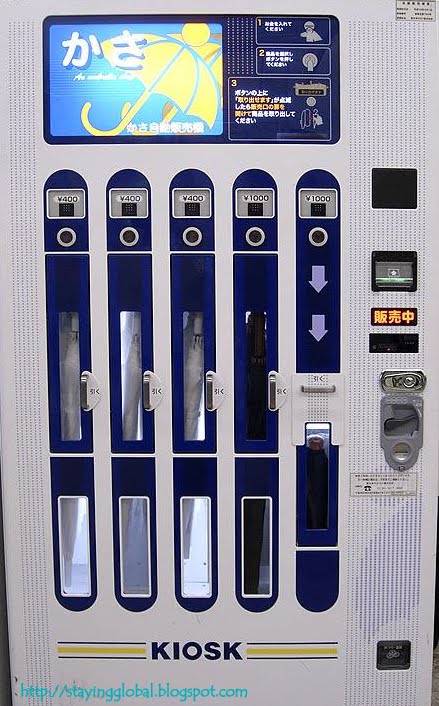
 Umbrella vending machine
                         
Disposable camera and camera film vending machine

There are some food joints where you order your food from a vending machine. You pay for the food and take the ticket at the vending machine, but the food is freshly prepared and served at the table or service counter. Talk about reducing queueing time ! A boon for foreigners - you can order by seeing the picture of the food rather than attempting to explain while ordering.

There are also Instant ramen vending machines :

There are shoe shine vending machines- insert a coin and get your shoe shined. Perfect for business travelers and office going people.
In some hostel type accommodation, people have to insert coins to use the showers and water runs for a particular period of time and to keep the water running you need to insert more coins.

Then there are the pay TV and VOD card vending machines in hotels across Japan.

Most vending machines accept coins in the denomination of 10,50,100 and 500 yen and offcourse notes of 1,000, 5,000 and 10,000 yen. Nowadays with “O-saifu Keitai” literally meaning “Mobile Wallet”  payment at vending machines can be made through cell phones. This service was introduced by NTT Docomo and now many other cell service providers also provide this facility. 

Loaded with a few 100 yen coins you can buy just about anything from vending machines in Japan. Do look out for interesting vending machines while in Japan and especially in Tokyo.  


And finally here is the Japanese word for the vending machine: "Jidohanbaiki". 

Manga Café

Yet another post on something uniquely Japanese - Manga Café.

Manga café is similar to a cyber café in many respects. However the basic idea differs. Unlike cybercafés, internet service is not the main feature here. Manga in Japanese stands for “Comics” and as the name suggests, Manga cafes are places where people read Japanese comics or Manga. These cafés do provide internet access and as such they are similar to a internet cafe.


Usually manga café’s are equipped with many shelves of manga, magazines and newspapers and vending machines stocking drink cans and at times also a food counter. Some manga cafes have music booths, slot machines, pool tables and also nail salons! 

The seating is divided into cubicles. Each cubicle may contain a chair or a sofa, table and a computer with internet access, and at times a printer and payphone. 

The charges usually start from 100 yen for 10 or 15 minutes  or an hourly rate. Some manga cafes operate round the clock and allow people to spend the night in the cubicles. Japanese youngsters sometimes use the manga café as a place to spend the night. I have heard that most often it is used as a snoozing place if people miss the last train home !

Wednesday, December 15, 2010

Capsule Hotels

Few things in Japan are unique to the country. Some of these are at times even unheard of or unimaginable to foreigners. One such thing is the concept of Capsule hotel.

A capsule hotel is a type of accommodation with very small rooms. The rooms are actually sleeping areas or blocks with barely any other space. The dimensions are usually 6.5 feet long *5 feet wide. Usually these spaces are not tall enough to stand. Usually these rooms or blocks are stacked side by side and are usually two tiered. They are actually said to resemble a bunk bed enclosed on three sides within walls. Usually a small ladder is connected for access to second level. But lack of space does not deprive users of basic facilities and entertainment. There are usually wi-fi internet services and even Television sets. Curtains or doors are also available to provide privacy. The hotels have common washroom facilities, lockers for keeping guest’s belongings, vending machines and at times also restaurants. Some capsule hotels also have saunas and common baths. Smoking and eating is usually not allowed in the individual capsules.

The capsule hotel was first introduced in Osaka and are now popular in Osaka , Tokyo and similar cities. These hotels are popular among men and more often among inebriated men. These are a cheap means of spending the night with room rent ranging between Yen 2000 to 5000. In the last few years, recession has reportedly made these capsule hotels more popular among the unemployed who cannot afford rented apartments in the big cities. 

Since I have not been to a Capsule Hotel, am sharing this link from the New York times. Click on the link to view a slideshow of pictures of a capsule hotel.
 http://www.nytimes.com/slideshow/2010/01/01/business/CAPSULESLIDE_2.html 

Osaki Hachimangu Shrine

On our way to Akiu Otaki, we drove around in Sendai . Sendai is one of the bigger cities in the Northern Honshu island and also in Tohoku region. I had read about the Osaki Hachimangu shrine and we decided to pay a visit when we found out that it was on our way to the Akiu Otaki.

The Osaki Hachimangu shrine is a Shinto shrine in Sendai city. The shrine deities are Emperor Ojin, Emperor Chuai and Empress Jingu. The deity is considered the guardian deity of Sendai.


The main shrine building, known as “Shaden” has been designated a National Treasure”.


The current structure was built in the 17th century as per the orders of Date Masamune, a powerful samurai. 

The shrine’s Matsutaki Matsuri which is held annually on January 14th is considered to be one of Japan’s leading festivals. It draws crowds from various parts of the country. This Matsuri has a 300 year history . The uniqueness of this festival is the giant bonfire called “Goshinka” which is lit as a farewell for the gods who visit people’s home during the new year. It is believed that dancing close to the fire purifies the mind and body and bestows good health. I am told that many believers dance around the fire , semiclad in clothes and braving the chilly winter night.


Address: 6-1, Hachiman-4-chome, Aoba-ku, Sendai, Miyagi pref- 980-0871

Phone: 022-234-3606

Access: 15 mins from JR Sendai station by car and
              15 mins from Sendai Miyagi IC ( Tohoku Expressway) by car

Thursday, December 09, 2010

Akiu Waterfalls

Our visit to Akiu Otaki was an unplanned one. We had spent the previous night at a hotel near Matsushima . We had finished sightseeing in Matsushima and decided to visit some other destination. We did a quick web search and came across information on Akiu Waterfalls. We decided to check it out.

Akiu waterfalls is supposed to be one of the three best waterfalls in Japan. This 55 m high and 6 m wide waterfall is located in Miyagi prefercture , on the outskirts of Sendai. The waterfalls are located a short drive away from Akiu Onsen and Spa resort town.  

The entrance to the waterfalls is through a Shrine complex. A walking path along the Shrine leads down to the Observation Deck. Unfortunately, the falls can be viewed only from a distance.
The observation deck is not very big and as such it was crowded.  But the view was spectacular.


We saw that a walking trail leads down to the main road but the trail was closed due to some construction work. We did get to see the falls in the distance as we drove back to Sendai . 

The Akiu Botanical gardens are located near the waterfalls. Just outside the shrine entrance there are various stalls selling food stuff, souvenirs and plants.

Akiu town is well known for its Onsens and Spa resorts.


We also visited the Rairaikyo Gorge while in the area.

There were'nt many signboards in English and we had to find our way around by asking lots of locals along the road.

Wednesday, November 24, 2010

Matsushima, Ah Matsushima !

In September this year, we visited Matsushima.

Matsushima is one of the three great scenic views of Japan called “Nihon Sankei”. It is said that the Haiku poet Basho was so mesmerized by the beauty of Matsushima, that he could not think of words to compose a haiku to describe it. It is said that the only words he could say were “ Matsushima, Ah Matsushima, Ah Matsushima, ah , Matsushima Ah! ”

Matsushima is a group of 260 islands in the Pacific Ocean. The name Matsushima means “Pine covered islands”. Most of these islands are actually tiny islets with no inhabitants. Due to the sea water and corrosion, these islands have strange shapes and few have acquired the shape of different creatures.


Best way to view these islands is a Cruise ride. The Marubun Cruise company is the most popular of the cruise companies that operate in the Matsushima Bay. We took the Cruise A which is a 50 minute round trip from Matsushima bay.  For more information on the cruise visit : http://www.marubun-kisen.com/english/matsushima/index.html

The other attractions of Matsushima are

Godaido Hall : It is a small islet off the coast connected to the mainland by a small bridge .


A small temple pavilion is  located on the island. The interior of the temple is open to public once in 33 years , the last being in 2006.
Admission: Free
Opening hours: 8:30 – 17:00
No closing days

Oshima Island:  This island also called Ojima was used as a meditation and training place by Zen monks.


There are lot of statues and rock carvings on this island along the walking trails.

This island can be reached on foot by a small red lacquered bridge called Togetsukyo Bridge.
Admission: Free

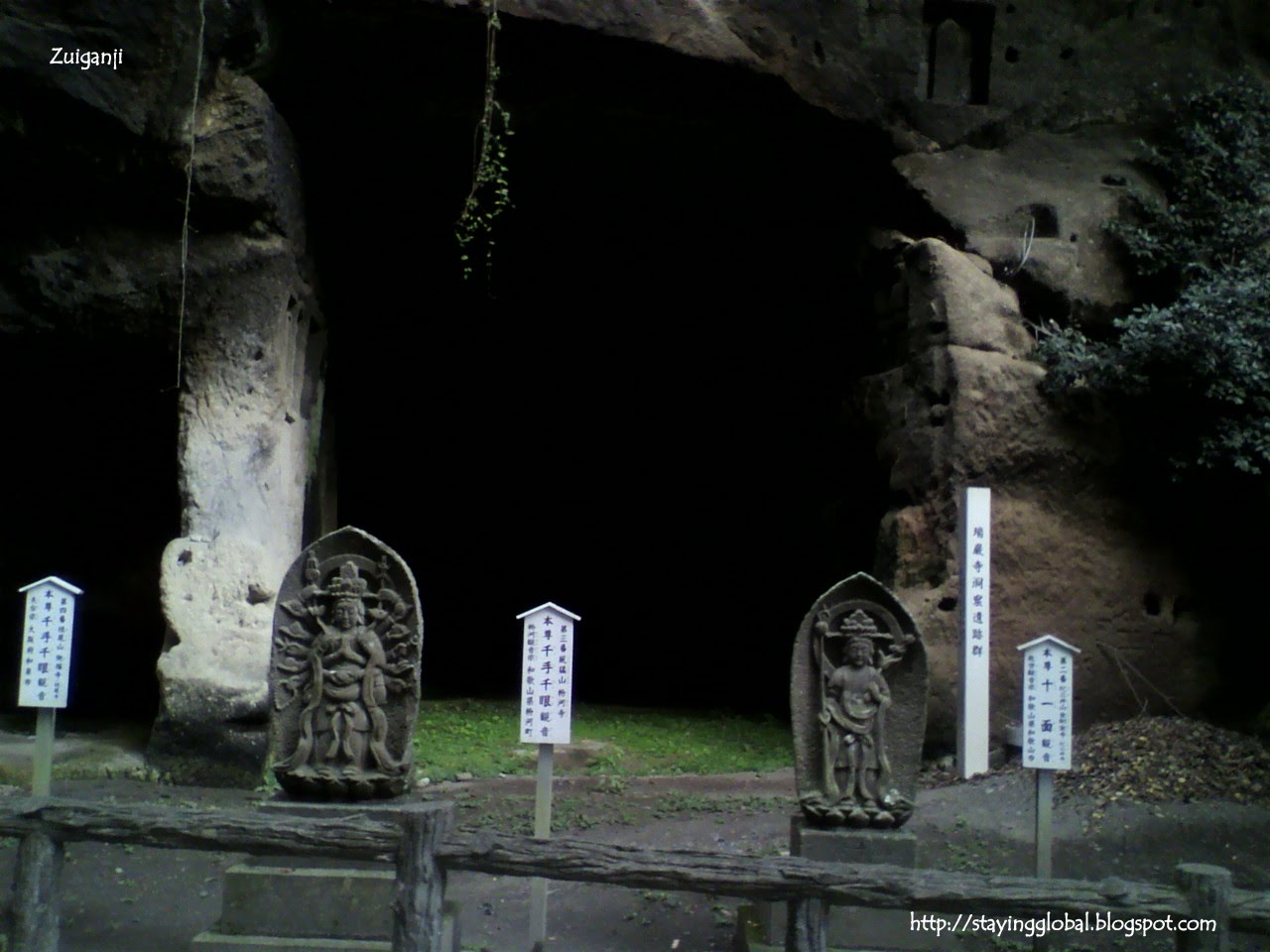
Zuiganji temple: This zen temple was originally built in the Heian period and the main hall contains precious paintings and carvings. This temple has been designated a national treasure. The entrance fee is 700 yen. The path from the entrance to the temple is lined on both sides by cedar trees.

There is also a path along moss covered Buddhist statues and caverns.


Kanrantei Pavilion: This is a tea house with a great view of the Matsushima bay. It is said that this was originally built in Kyoto by Shogun Toyotomi Hideyoshi who gifted it to Date Tadamune  who moved it to Matsushima.

Fukuurajima: This island is connected to the mainland by a 250 meter long vermillion coloured foot bridge.

A toll of  200 yen is payable for using the bridge. There are many walking trails on the island. Not very spectacular considering it is covered with lots of wild plants and weeds. It is more of a botanical garden than a  tourist spot.

Masamune Date, the feudal lord is said to have had a special liking for Matsushima. Many structures in the Zuiganji temple complex and the Godaido hall was constructed on his orders.

Matsushima  is located in Miyagi prefecture . Matsushima is one of the most visited destinations in Tohoku. The proximity to Sendai makes Matsushima easily accessible.  Hotel reservations are necessary. Weekends can be crowded and traffic within the town could be slow. Paid parking is available next to the Ojima island and near the Matsushima Bay and most places are only a short walk away. The train station is also a short walk from the Matsushima Bay. Easiest and most convenient way to travel around in Matsushima is on foot.

The entire town can be covered in one day or approximately 5-6 hours.

When in Matsushima, do try the fresh seafood. Lots of food stalls and joints sell oyster, squid and clam delicacies.  

Shichi-Go-San

15th November is a special day in Japan. It is the day of Shichi Go San. Literally, Shichi Go San means 7-5-3.

Shichi Go San is a traditional rite of passage for Japanese boys and girls. The uniqueness of this festival is that this day is celebrated for 3 and 7 year old girls and 5 year old boys. It marks the passage of children into their middle childhood and as per Japanese numerology these odd ages are lucky for children.
This festival originated in the Heian period and has evolved over the centuries. In the ancient days boys had to shave their heads till they attained age 5 after which they could grow hair. For girls it meant changing the pattern of kimono or the cords which they tied the kimono with. The samurai class observed Shichi Go San till the Meiji period when it was adopted by common people. 
These days, children of this age are dressed in kimonos and along with parents they visit the Shrine and pray for good luck and health and success in their future.
Parents give children a special candy called “ Chitose Ame” which literally means “ Thousand Year Candy”. It is red and white in colour and is long and thin and is wrapped in edible rice paper film. The bag carrying this candy has a crane and turtle printed on it. Both crane and turtle are considered as symbols of long life in Japan.

Shichi Go San is not a holiday and as such these days it is common to see people observing it on a weekend around this time of the year.

Tuesday, November 23, 2010

Autumn in Japan

After the hot and humid summer months from June to August, everyone in Japan looks forward to Autumn. Come September and the signs of autumn are evident everywhere.  The weather is pleasant, the days are bright and nights are longer. The most visible sign however is the change in the trees, plants and grass.

 The leaves change colour from green to various hues of yellow, orange, red and brown before they fall off leaving the trees and plants barren till spring arrives. The most colourful of all the trees are maple and gingko. The deep red colour of the maple leaves and the bright yellow gingko leaves are a treat to the eyes. The Japanese word for maple and autumn season both is “Momiji”. 

 The beauty of autumn is a sight to be seen and experienced. The panorama of colours is truly one of the most beautiful creations of nature.

 The golden and crimson hues of the leaves are well complemented by the fruit laden trees. Mandarin oranges known as “Mikan” in Japanese and Persimmon known as “Kaki” in Japanese can be seen hanging from trees everywhere. 

Autumn viewing is a popular activity in Japan and in Japanese it is called “Momijigari”. On weekends families and groups of friends get together and go out to autumn viewing spots. There are popular autumn viewing spots in almost all of Japan. The locals know the exact timing to visit these spots. There are various websites in Japanese which predict the best time to visit these spots and the locals track these sites regularly to know the best time to visit these spots. Autumn viewing season begins usually around early October and ends during Mid November. Autumn colours have a pattern here . The colours first begin to change in the north and eastern part of Japan moving southwards and towards the west. Autumn arrives earlier in Hokkaido than in Kyushu and Okinawa and ends there earlier too. At many places the local shrine or the local authorities organize an autumn festival called as “Momiji Matsuri”. This is held usually at the peak of autumn in that area. In most of the tourist destinations and shrines there is special illumination at night during the autumn colours. Kyoto’s Kiyomizudera and Mt Tsukuba in Ibaraki prefecture are two of the most popular places for the night illumination during Autumn.

 It is said that the autumn is especially spectacular in the Tohoku region which comprises the prefectures of Aomori, Akita, Miyagi, Yamagata, Iwate and Fukushima. Autumn arrives in early October and lasts for over a month till the leaves begin to fall off in mid to late November. As such autumn in Tohoku is longest compared to other parts of Japan. This year was our first autumn in Japan. Based in Iwaki, it was easier for us to cover a lot of places in Tohoku region, Tochigi and Ibaraki prefectures during the weekends.

Our first trip was to the Bandai region in mid October. I had posted pictures of this trip in an earlier post. Our next autumn viewing trip was to the Hananoki Valley in Ibaraki prefecture.

The Shiomitaki bridge is a popular spot. This is a suspension bridge with colourful trees on both sides and a small waterfall beneath.

 A small trail along streams and small waterfalls leads to the bridge.

 This spot is crowded during autumn and finding parking is a bit difficult.
The website link for tourist information (in Japanese) is  http://www.takahagi-kanko.jp/turn_red

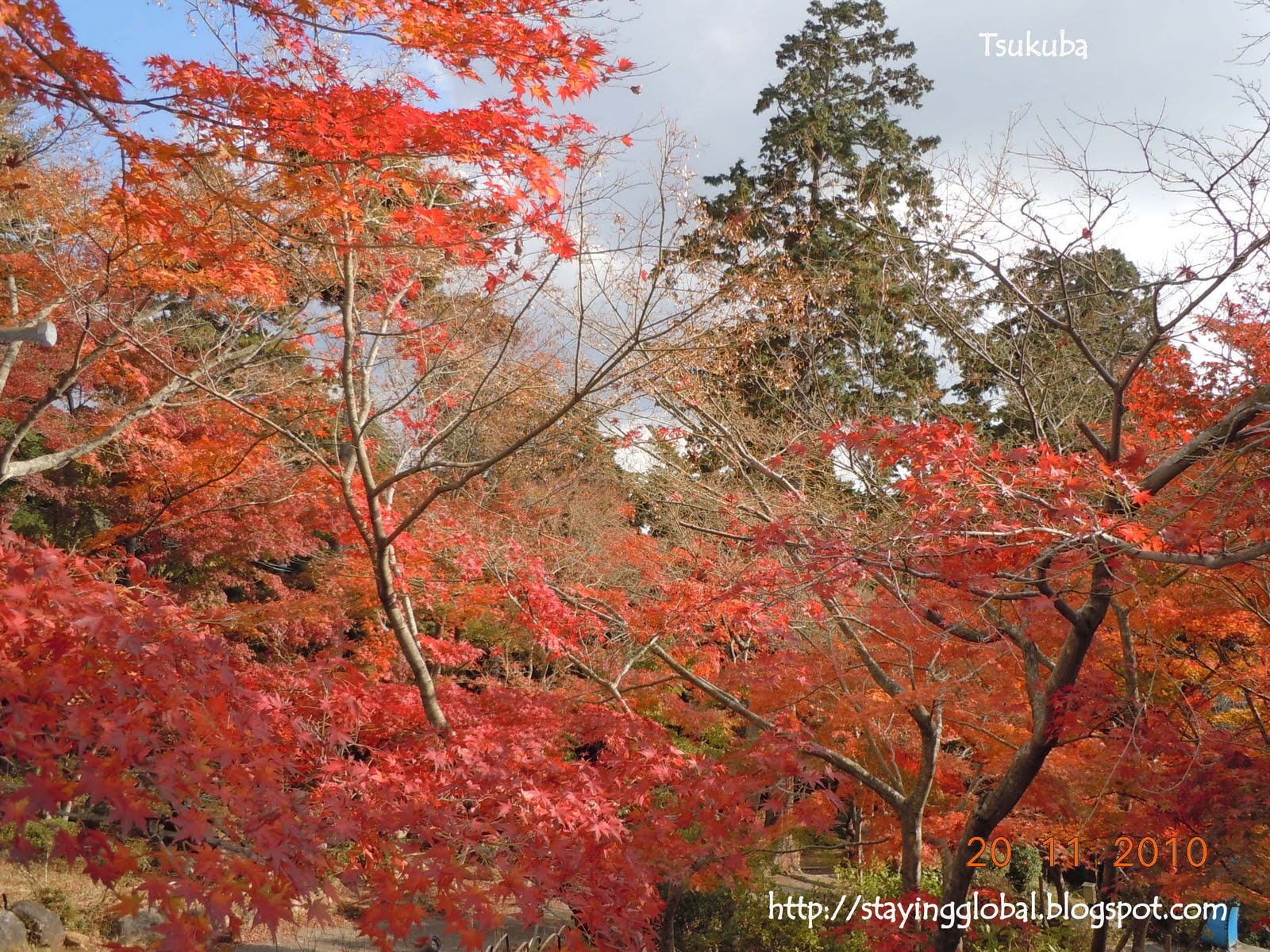
Our next trip was to Mt Tsukuba in Ibaraki prefecture.

The Tsukubasan shrine is located at the base of the mountain. Maple trees and other trees around the shrine make it a colourful place.

A 9 minute cable car ride takes visitors uphill to the observation point. This observation point is located between two mountains, Mt Nantaisan and Mt Nyotaisan. The cable car ride offers good views of the autumn colours.

The cable car fare for adults is 570 Yen (oneway) and 1020 yen (roundtrip). For enthusiastic hikers, there is a steep hiking trail which takes you to the top of the mountain and it takes about 2.5 hours to reach the top. There is a ropeway from Mt Nyotaisan to Tsusujigaoka. The ropeway fare for adults is 600 Yen (oneway) and 1070 yen (roundtrip).

When we visited Mt Tsukuba on 20th November it was almost the end of autumn in that region and we couldn’t see the full bloom. The Momiji Matsuri had taken place a week earlier. The phone number of the tourist information center is 029-866-0502 and 029-866-0611.


Iwaki has its own share of autumn beauty. Maple and gingko trees along roads make driving around the city a pleasant experience.

Iwaki park and other gardens in the city offer good autumn views. The best however is the sight of the garden at Shiramizu Amidado temple.


 We had first visited this temple during summer. However the sight of the temple and the garden had transformed completely during our visit the last weekend.

The temple is a national treasure. The hall houses 5 statues of Buddha. However the garden of the temple is the main attraction.

A walking path takes visitors around the temple through trees and around a pond.


The beauty of the garden is exceptional in autumn. Entrance : 350 yen. Open : 8.30 am to 4.00 pm . Phone : 0246-26-7008

In Japan every season has its own speciality and the cuisine too changes with the season. Autumn is the season for “Oden” It is a stew consisting of a mix of eggs, radish, fish cakes, and konyaku (devil’s tongue) boiled in a broth of soy flavoured broth called Dashi. It is also popular during winter and is available at convenience stores, roadside joints and department stores too. The ingredients change from place to place. We had first tasted Oden in South Korea last year. In South Korea it is called “Odaeng” and is a popular dish in the cold seasons. The other autumn delicacies in Japan are Mushrooms, Pine Nuts, Gingko nuts and Chestnuts.

Children enjoy collecting Acorn, Chestnuts and Pinecones which are known as “Donguri”, “Kuri” and “Matsubakuri” in Japanese. Infact kindergartens and elementary schools organize nut collection outings in autumn.

To sum it up, Autumn is an enjoyable season in Japan especially for travellers and nature lovers.