Pages

Monday, April 09, 2012

Entrance Ceremony: Beginning of a New School Year


Come April and lot of changes take place in Japan. Almost anything new and important begins on or after 1st April. The arrival of spring also marks the beginning of the new fiscal year and also the beginning of a new school year.

Back in my country, the beginning of the school year is not marked by any ceremony. In Japan, however the new school year is marked with a special “Entrance” ceremony. Personally I liked this concept as students look forward to the beginning of the new academic year and it is always good to make the first day enjoyable, especially for new students who would otherwise be slightly nervous on their first day in a new setting.  

Entrance ceremonies are usually held across Japan in early April. These ceremonies are held in all schools- right from Kindergartens to High School. In kindergartens, these ceremonies are called “Nyuuenshiki” while in Elementary to High schools these are called “Nyuugakushiki”.

Typically these ceremonies are held in the school gym and are attended by the students and their families. The children dress in their school uniforms while parents dress formally. Few parents also dress up in their colourful kimonos. Some times grandparents also participate in the Entrance ceremony.In a typical ceremony, the old students and the parents are seated in the gym and the new students march in to a round of applause, welcoming them. The principal of the school then addresses the gathering, with encouraging words for the students. Then the homeroom teachers are introduced. Then PTA members or other teachers/ student representatives may also make short speeches. The ceremony ends with the students singing the school song. After this the students are led to their new classrooms by their teachers who then brief the students about the various activities lined up in year ahead. Commemorative class pictures are then taken which marks the end of the first day of the school. 

This week, we too attended an “Nyuuenshiki”- entrance ceremony at our daughter’s kindergarten. Her school is managed by a Buddhist temple and the entrance ceremony here includes certain Buddhist rituals. 

The school gym podium had a Buddhist altar in the centre. 
At one end was a wooden Elephant with a small Buddha statue on it.  
At the entrance to the gym, scrolls carrying names of each the students in calligraphy were put up.
The ceremony began with the principal and three children dressed in traditional attire walked up the podium, bowed before the altar, placed flowers and lit candles. 
This was followed by everyone bowing in prayer. Then the principal made a speech welcoming the students to a new year. Then a Buddhist priest addressed the gathering and said encouraging words to the children.
 This was followed by all the children singing the school song. The Japanese course students sang in Japanese while the International course students sang in English. After this the homeroom teachers and the English teachers were introduced. 
The school bus drivers were also introduced. Then two priests walked up the podium for the blessing ritual. The children walked up to the podium and each one was blessed with sprinkling of holy water. 
Then a PTA member addressed the gathering. After this the ceremony concluded and the children were led to their classrooms by their teachers, followed by their parents. The children played in their playrooms, while the teachers briefed the parents about the year ahead. Activity calendar for the year, important announcements and the bus schedules were handed out. After this we all walked back to the gym where commemorative group picture of the students,teachers and parents were clicked. After this we all went home, the children bidding goodbye to their friends, enthusiastic about going back to school the next day.  

Our 5 year old daughter, attends the International course at a local Kindergarten (Kuhonji Kindergarten in Iwaki city) and it is an interesting mixture of Japanese and International (basically American) education. The children get to learn both Japanese culture and language along with English and western culture. End of the day, she (and through her, we) gets to learn a lot about Japanese customs, traditions, festivals and language along with improving her English. 

Wednesday, April 04, 2012

Welcoming spring at Mito's Kairakuen


In Japan, spring is synonymous with blossoms. After the dry and cold winters, spring brings with it a new hope, new joys and warmth. The trees which have worn a barren look in the winter months are filled with buds about to blossom. While the leaves are yet to sprout, the blossoms light up the trees and bring cheer to onlookers.
Spring is known as “Haru” in Japanese. Spring has always had special importance in Japanese culture. Schools and universities begin their new academic term in Spring. Many people make important changes in their life especially around spring. No wonder, spring is associated with celebration. I have in earlier posts written about Sakura and Hanami, two words which give a special meaning to spring in Japan.

While Plum blossoms signify the beginning of spring, Cherry blossoms mark the end of spring.
People anxiously await the blossom season and don’t miss an opportunity to visit the various popular blossom viewing spots. There are many popular blossom viewing spots all over Japan, from Hokkaido to Okinawa. Most popular places have a “Matsuri”, seasonal flower festival( usually associated with Sakura- cherry Blossoms) and these events are well received and attracted large crowds.
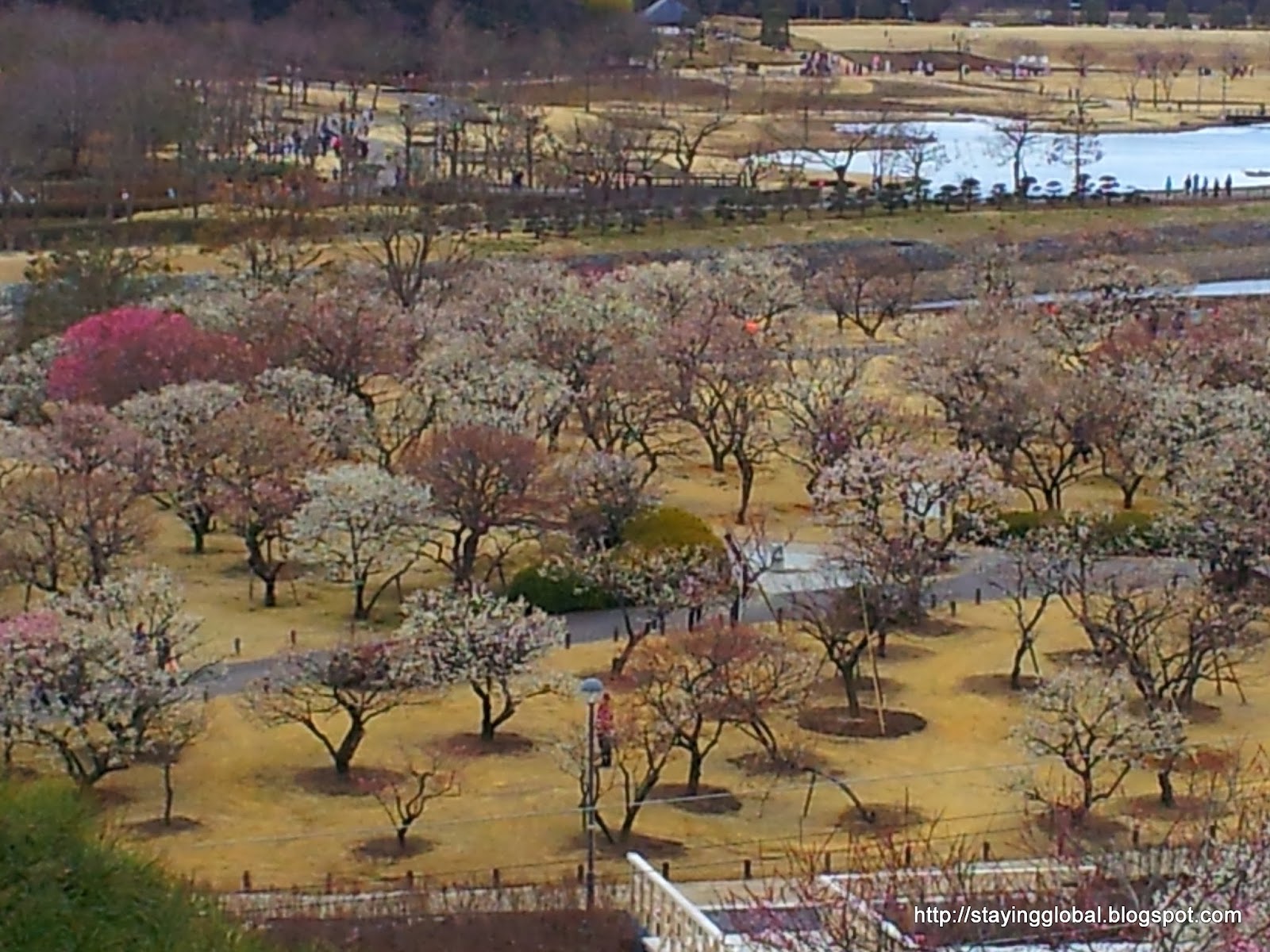
 Like last year, this year too we visited Kairakuen, in Mito city, Ibaraki prefecture to attend the “Ume Matsuri”. “Ume” or Plum blossoms, bloom towards the beginning of spring. Mito’s Kairakuen, holds its annual “Ume Matsuri”  between Mid February – March 31st. Built in 1841 by  Nariaki Tokugawa, the ninth lord of Mito, Kairakuen is regarded as one of Japan’s three finest landscaped gardens. Built in times when such pleasures were reserved for only the rich and wealthy, the Kairakuen was open for general public and this is one of its rare distinctions.
Kairakuen’s grounds have over 3000 plum trees with over a hundred varieties. Blossoms in shades of white, pink and even green were in full bloom during our visit.


Walking trails around the park offer good views of the blossoms and also the nearby Senba lake.  


On our visit to Kairakuen in March 2011, we saw kimono clad ladies posing for groups of photographers, a common sight during such matsuris.
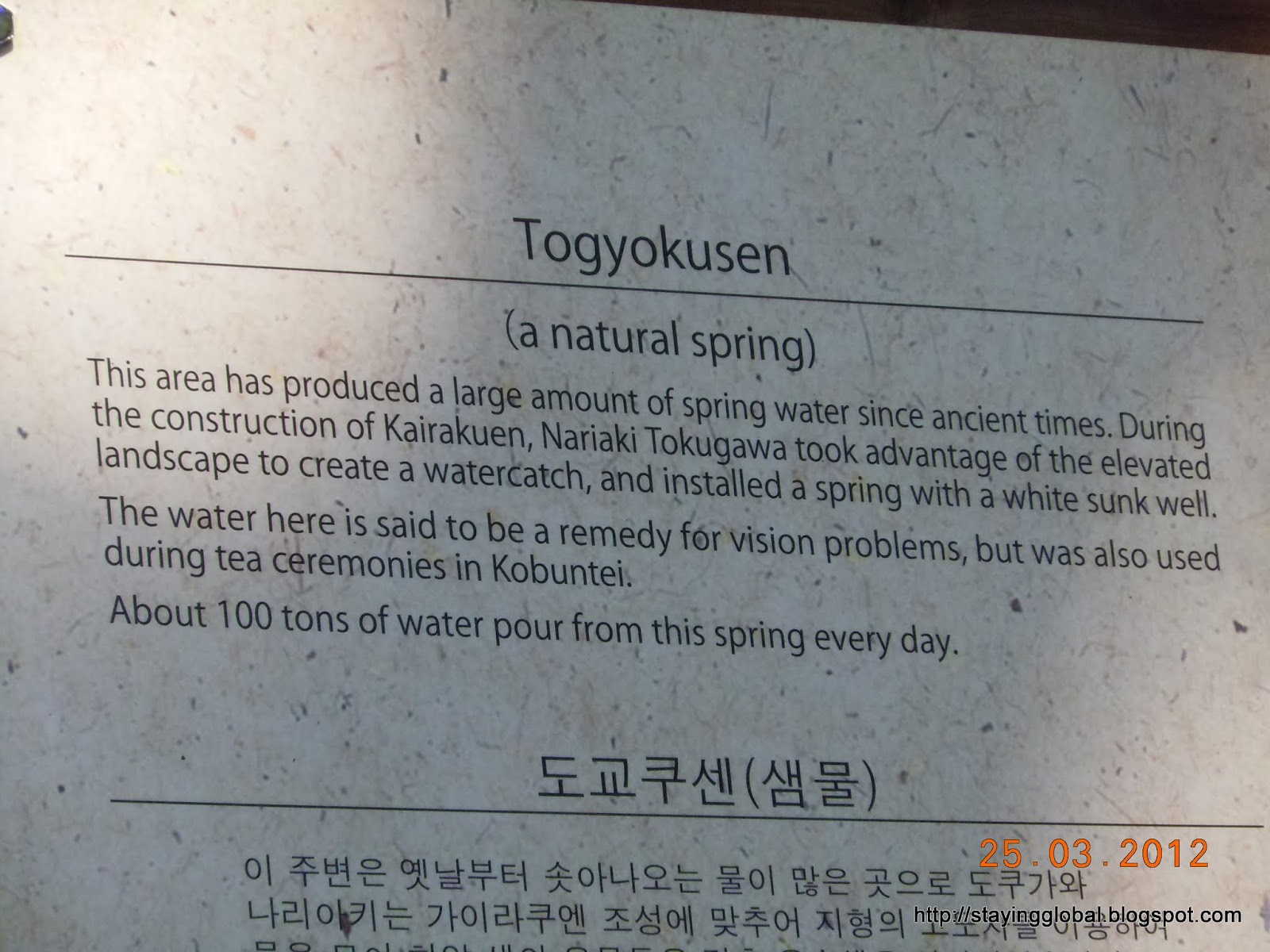
A cedar grove and a bamboo grove can also be seen in Kairakuen. Kobuntei, a traditional Japanese style wooden building also stands on one end of the park.A natural spring inside a granite basin is said to have medicinal powers especially for treating vision problems.

Tokiwa Jinja, a Shinto shrine is situated adjacent to the Kairakuen. 
One of the deities enshrined in the shrine is Nariaki Tokugawa, the person who constructed Kairakuen. The other deity is Tokugawa Mitsukuni, the second lord of Mito clan, who was also a grandson of the founder of the Tokugawa shogunate, Ieyasu (who is enshrined in the Toshogu shrine at Nikko 
Though the park is open all year round, the Ume Matsuri period is undoubtedly the best time to visit. It is crowded during weekends and parking can be difficult to find. The road leading to Kairakuen is also congested during this time. The Kairakuen station on Joban line functions, only during the Ume Matsuri period to facilitate tourists. 

Address: 1-1251, Migawa, Mito city, Ibaraki Prefecture,

Phone: 029-244-5454

Admission : Free entry to Kairakuen, 190 yen for entry to Kobuntei.
  

Spending Half a day in Utsunomiya

On our recent trip to Nikko and Oku Nikko, we stayed in Utsunomiya and travelled in the Nikko area on day trips. By Day 3 of our trip, we were done sightseeing Nikko and Oku-nikko and still had another half a day before returning home to Iwaki. We decided to explore Utsunomiya city. When we asked the hotel staff to recommend tourist spots, they were at a loss to come up with any suggestions. True to what they said, Utsunomiya is not a city with much on offer for tourists. Utsunomiya is the administrative capital of Tochigi prefecture and tends to be more of a commercial centre. Since we still had that half day on hand, we decided to explore Utsunomiya nevertheless.

Utsunomiya is associated with “Ohya-ishi”, (Ohya stone) which was created out of volcanic activity more than 2000 years ago. The stone is popular for carving and sculpting because it light and easy to process and is durable at the same time. It has greenish tinge and is easily distinguishable from other kinds of stones.
A short distance away from Utsunomiya’s city centre is Ohya Park, an Ohya stone quarry. The underground quarry ruins have an all year round temperature of 13 deg C and help visitors understand history of the stone and its quarrying. However when we visited, it was closed.

Nearby is the Oyaji temple, founded in 810. 
The temple sits beneath huge Ohya rocks.


The relics are called Oya Magai-butsu. A cave like passage next to the temple has carvings of Buddha on the rock wall. 
An exhibition hall and a small Japanese style garden are found adjacent to the Oyaji temple. 

The temple and the relics are designated Important Cultural Properties and Special historical site.

Across the road is a 27 meter high Heiwa Kannon statue carved on Ohya stone. 
The statue was created in 1948 as a memorial to those who died in the World War II. It took 6 years to complete the statue. 
A staircase next to the statue takes visitors upto the side of the statue. 

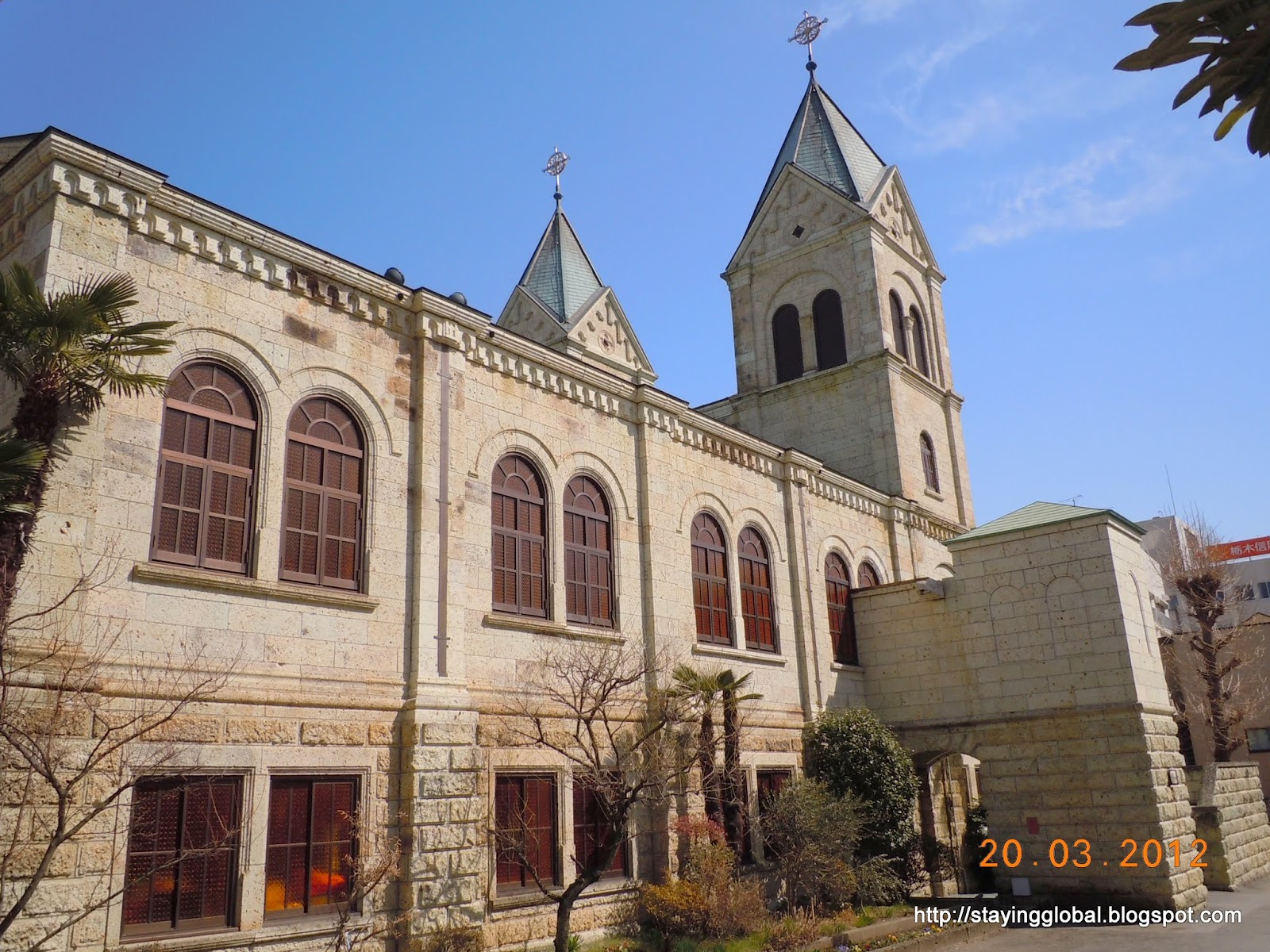
The catholic Matsugamine church built in 1932 is also made of Ohya stone and has been built in the style of Roman cathedrals. 

The church is a registered national cultural property.

Close to the Matsugamine church is the site of the the erstwhile Utsunomiya Castle. 
This castle was used by the emperor or members of royalty as a rest house before proceeding on their journey to Nikko. 

Nothing remains of the castle, but a part of the castle has been reconstructed and a park has been built around it, and serves as a recreation spot for local residents.

Futarayama Shrine is Utsunomiya’s most popular shrine. 
The shrine was erected 1600 years ago and the spirit of Utsunomiya’s founder is enshrined here.
 Sitting atop a hill, a massive stairway leads from a large open space to the shrine. 
The shrine is in central Utsunomiya and is close to Parco departmental store. The shrine is also illuminated from sunset to 10:00 pm every evening.

Bronze Statue of Buddha of three Soybeans is a 3.6 meters high Buddha statue which is installed on a small Buddhist temple’s ground in 1735. 
It has an interesting folk tale associated with which goes that when locals wanted to construct a Buddha statue, they were short of funds. A priest handed over three soy beans and predicted that when cultivated these beans would raise enough money to build the statue. 

The last place we visited in Utsunomiya was a place called “Romantic Mura”. 
The park sits over 48 hectares and has an onsen, a brewery, farmers market, food court, flower shop and most interestingly a Flower Dome.Flower dome is an indoor recreation of tropical climate has been created and tropical plants and herbs are grown.

Visitors can also walk around on the many walking trails in the park. 


Utsunomiya is most famous for its “Gyoza”, Japanese dumpling with a meat or sea food filling. It is similar to the Chinese Dimsum and Korean Mandu (the Korean version is a personal favourite). There are hundreds of restaurants and food joints selling their own “unique” Gyoza. Some joints proudly display pictures or autographs from celebrity clientele.I was told that people from Tokyo and surrounding areas sometimes visit Utsunomiya just for its Gyoza. Not sure if it is true or just an exaggeration of the popularity of Gyoza!